
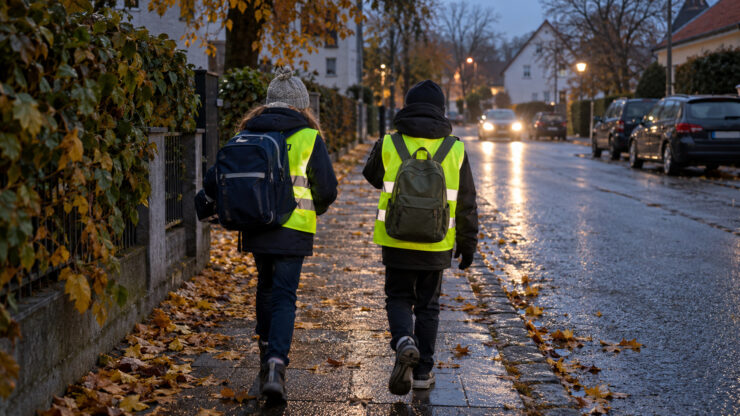

Parents and school buyers often assume any brightly coloured vest will keep a child visible. That assumption is risky. In Europe, children’s enhanced visibility clothing is now covered by EN 17353:2020+A1:2025, but many stores and suppliers still sell items labelled with the withdrawn EN 1150 standard. This guide explains what EN 17353 actually requires for children’s reflective vests, how to check compliance, and where to look for reliable accessories.
Why Children’s Reflective Vests Matter (and the Recent ADAC Warning)
Children are small, move unpredictably, and often walk or cycle in low light. A reflective vest is a simple way to make them stand out to drivers. But not all vests work equally well. A recent German automobile club test of 25 children’s high-visibility vests found enormous defects in visibility, with many products falling far short of the performance needed for safe use.
One practical concern raised by outdoor education specialists is that if every child in a group wears the same high-visibility jacket, the group can blend together rather than help individuals stand out. In crowded school settings, it is worth thinking about when and where vests help most, not just assuming more fluorescent fabric is always better.
Local governments have recognised this. In Tokyo, local authorities have distributed reflective vests for children on school routes. A national automobile association in Japan also ran a project to develop highly visible vests with fluorescent and reflective materials for safe school commuting. These initiatives show strong institutional demand, but they only work if the products meet a recognised standard.
The Shift from EN 1150 to EN 17353:2020+A1:2025
For years, children’s high-visibility waistcoats in Europe were tested to EN 1150:1999. That standard covered non-professional use, but it is no longer the current route to CE marking for these products. EN 1150 has been superseded by EN 17353:2020, with the latest amendment A1:2025. The new standard covers enhanced visibility equipment for medium-risk situations and applies to clothing and accessories for pedestrians, cyclists, runners and low-speed workers.
Despite this, many retailers and importers still advertise children’s vests as EN 1150 certified. In the UK, some school suppliers market vests with EN 1150 certification specifically for school walking buses. In Spain, you can still find yellow vests with children’s prints sold with EN 1150 markings. This is not a minor labelling issue. If a product carries an outdated standard reference, buyers cannot be sure it meets current EU requirements.
EN 17353 introduces more flexible design types than EN 1150, including garments and accessories that do not have to fully wrap the torso. But with that flexibility comes the need to check which type, class and area the product actually meets.
Key EN 17353 Requirements for Children’s Vests (Design & Area)
EN 17353 splits products into three visibility types:
- Type A – fluorescent material only, for daylight visibility.
- Type B – reflective material only, for visibility under headlights at night.
- Type AB – combines fluorescent and reflective materials, giving the broadest protection in both day and low-light conditions.
For a vest meant for children on roads, Type AB is usually the most appropriate because it works at dawn, dusk and night. Within Type B and AB there are classes B1, B2, B3 and AB1, AB2, AB3, which refer to the design and placement of reflective elements, not just the amount.
The standard sets minimum areas of fluorescent and reflective material. For children under or equal to 140 cm in height, the requirements are different from adult sizes. According to our reading of EN 17353, children’s sizes entirely below 140 cm need a fluorescent area of at least the minimum specified for the garment’s size and type and, for B3/AB3 designs, a reflective area of at least the minimum specified for the garment’s size and type. Sizes that cross the 140 cm threshold must meet the adult area values. These numbers are easy to get wrong in production because many suppliers simply scale down adult patterns without recalculating the material coverage.
We have written a separate article on the exact fluorescent and reflective breakdown for Type AB3 vests, including the 140 cm cut-off: EN 17353 AB3 Safety Vest: Fluorescent and Reflective Areas for Children and Adults.
Another common error is using reflective tape that meets EN ISO 20471 performance values but not checking the EN 17353 area and design rules. In our experience, the same reflective tape can often be used for both standards, but the minimum area, placement and product type change. A vest certified under EN ISO 20471 may not automatically meet EN 17353 AB requirements.
The 140 cm Height Rule: Sizing Children’s Safety Gear Correctly
Children’s vests are frequently sold by age brackets – for example, 2-3 years, 4-6 years, or 10-12 years – rather than by height. This causes serious compliance problems. EN 17353 defines a children’s size category only for garments intended for users with a height of 140 cm or less. If a size range crosses above 140 cm, the adult area requirements apply.
We have found that many importers mix sizes in one SKU, such as a one-size-fits-8-14-years vest, without realising that the taller end of that range triggers adult areas. To be safe, buyers and schools should ask suppliers for a size-to-height chart and confirm which area table was used for each production size.
For a detailed explanation of the 140 cm rule and how to design children’s garments to meet it, see our article: Designing EN 17353 Children’s Garments: The 140 cm Height Rule.
How Parents and Schools Can Check for CE Compliance
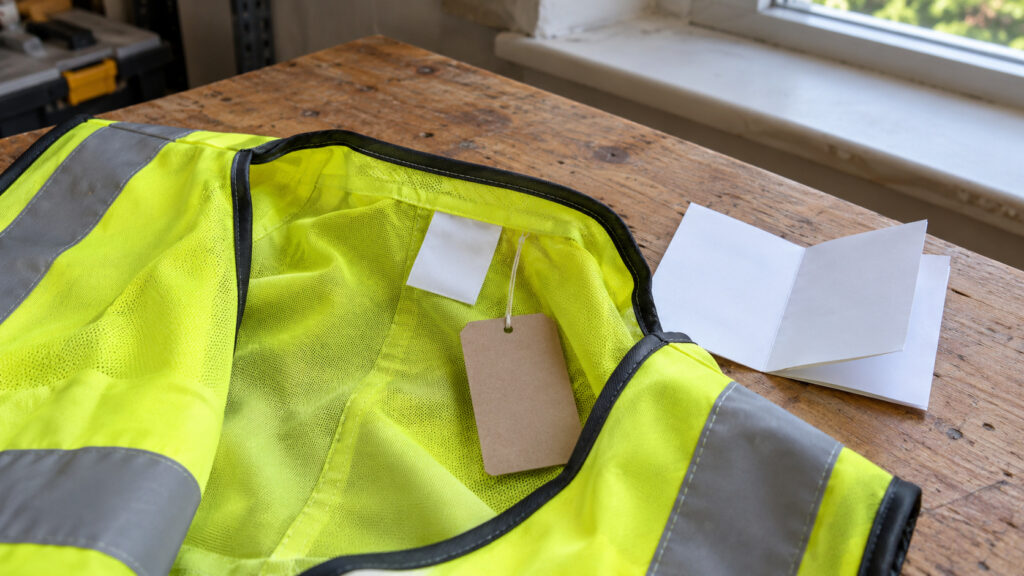
- Look for the CE mark and the standard number on the label or attached tag. It should say EN 17353:2020 or the amended version, not EN 1150.
- Check the pictogram or type code. The label should state the visibility type (A, B or AB) and class where applicable, such as AB3.
- Ask for the EU Declaration of Conformity. This document is mandatory and must list the exact product, the standard version, and the notified body if required.
- Check the care instructions. Washing can destroy reflective tape if not done according to the manufacturer’s rules. Some premium vests are tested to withstand up to the limit stated in their test reports for repeated washes, but this is not a standard requirement, so ask for evidence if a supplier claims high wash durability.
- Inspect the reflective tape placement. For a Type AB vest, the reflective bands should be positioned so they are visible from the front, back and sides. If the vest is mostly fluorescent with only a tiny reflective logo, it is unlikely to meet the required reflective area.
Safety blogs often recommend checking for a CE mark or standard number, but they sometimes still point to EN 1150 or EN ISO 20471 instead of EN 17353. For a children’s reflective vest used outside professional high-risk work, EN 17353 is the correct current reference. EN ISO 20471 is for occupational high-risk use and has different area and colour rules.
Beyond Vests: EN 17353 Certified Accessories for Extra Visibility
A full vest is not the only way to increase a child’s visibility. EN 17353 also covers Type B1 reflective pendants, Type B2 slap bands and elastic arm bands, and even reflective harnesses for children. These accessories can be useful when a vest is impractical, but they must be worn correctly. For Type B1 and B2 items, the standard requires them to be used as a pair in most cases, one on each side of the body, so that a driver sees reflective points from both directions.

Our company, Yuyao Kean Reflective Products Co., Ltd., runs en17353.com to explain this standard. We hold EN 17353 certificates for Type B1 soft reflective pendants, Type B2 slap bands, Type B2 elastic arm bands, and a children’s harness. We do not currently hold an EN 17353 certificate for full vests, so we are careful not to claim otherwise. Many of our products use 3M Scotchlite or Reflexite reflective materials, which are widely accepted by notified bodies when the tape meets the required RA values.
For a closer look at Type B2 arm bands and slap wraps, see: EN 17353 Type B2 Explained: Arm Bands, Slap Wraps and Limb Reflective Garments.
Sourcing Reliable Reflective Gear for the European Market
Importers and procurement managers face a flooded market where old EN 1150 stock still circulates. A low price often means the supplier has not updated the technical file. When buying children’s reflective vests for the EU or UK, request not only the test report but the full technical file, including design drawings, layout of reflective bands, and washing test results. A valid CE certificate for one product type does not cover other types; for example, a certificate for a B2 slap band does not make a vest compliant.
Be especially careful with fashion-oriented vests in dark blue, fuchsia, or with dinosaur and unicorn patterns. While these may look appealing to children, the fluorescent colour and area are what provide daytime visibility. A patterned vest made mostly of dark fabric may fail the EN 17353 fluorescent colour and area requirements even if it has some reflective strips.
If you are comparing EN 17353 with EN ISO 20471, remember the intended use. EN 17353 suits consumer, children’s and sports products; EN ISO 20471 is for professional high-risk workers. Our comparison article can help: EN ISO 20471 vs EN 17353: Which Reflective Vest Standard Fits Your Needs?.
FAQ
Should children wear high visibility vests?
Yes, when they are near traffic in low light or poor weather, a vest that meets EN 17353 significantly improves their visibility to drivers. However, the vest must meet the correct standard and be worn properly, not just be bright in daylight.
What is the difference between EN 1150 and EN 17353 for children’s vests?
EN 1150 was the older standard for non-professional high-visibility clothing and has been superseded by EN 17353:2020, now updated to EN 17353:2020+A1:2025. EN 17353 covers more product types, requires specific fluorescent and reflective areas, and includes special rules for children up to 140 cm tall. A vest marked EN 1150 today is likely a legacy or non-compliant product.
How can I check if a child’s reflective vest is CE certified?
Look for the CE mark and the standard number EN 17353 on the label. The label should also state the visibility type (A, B or AB) and class if applicable. Ask the seller for the EU Declaration of Conformity and, if necessary, a test report. If the label says EN 1150 or EN ISO 20471 without a specific reason, treat it with caution.
Are patterned or dark-colored children’s vests compliant with safety standards?
Usually not. EN 17353 requires the fluorescent material to meet specific colour and luminance requirements and cover a minimum area. Dark blue, fuchsia or heavily patterned vests may have too little fluorescent background, so even with reflective strips they can fail the daylight visibility requirements. They might still be useful as a fashion item, but not as a certified safety garment.
How many times can you wash a children’s reflective vest before it loses visibility?
There is no universal number in EN 17353. Some manufacturers test their vests to withstand up to the limit stated in their test reports for repeated washes, but this is a product-specific claim, not a standard requirement. Always follow the care label and ask the supplier for washing durability evidence if they make a high wash-count claim.
This article is guidance only. The official EN 17353:2020+A1:2025 standard text prevails in all cases.