
Reflective tape used in EN 17353 Type B2, Type B3 and Type AB products has to pass two hurdles: a high coefficient of retroreflection when new, and a retained minimum after abrasion, cold, heat, rain and cleaning. Many material datasheets show only the first number. Buyers and product developers need to see both.
This guide summarises the retroreflective performance and durability requirements in EN 17353:2020+A1:2025 for garment and device materials. Free-hanging Type B1 devices follow a separate route, covered in our Type B1 guide.
Retroreflective requirements at a glance
| Point | Separate-performance retroreflective material | Combined-performance material |
|---|---|---|
| New material, observation 12′, entrance 5° | ≥ 330 cd/(lx·m²) | ≥ 65 cd/(lx·m²) |
| After test exposure, observation 12′, entrance 5° | > 100 cd/(lx·m²) | > 30 cd/(lx·m²) |
| After rainfall | > 100 cd/(lx·m²) | > 15 cd/(lx·m²) |
| Orientation sensitive material | Full requirement at one orientation, at least 75 % at the other | |
1. Separate-performance or combined-performance?
EN 17353 recognises two kinds of retroreflective material:
- Separate-performance material is either fluorescent or retroreflective, not both. Typical silver reflective tape belongs here.
- Combined-performance material is both fluorescent and retroreflective, for example a fluorescent yellow reflective film.
The distinction matters because the photometric tables are very different. Separate-performance material must reach 330 cd/(lx·m²) at the main measuring geometry when new; combined-performance material must reach 65. Combined-performance material is used in Type AB equipment and must also satisfy the fluorescent colour requirements.
A combined-performance material whose retroreflection reaches the separate-performance values can be counted as separate-performance material for the Type B3 area calculation.
2. New-material photometric testing
Retroreflection is measured according to CIE 54.2. The full requirement table covers observation angles from 12′ to 1°30′ and entrance angles from 5° to 40°. The 12′/5° value is the headline figure, but the material has to meet the whole table, including the wide-angle values that represent light arriving from the side.
The test specimen is a 100 × 100 mm piece of the material, or several elements as used on the finished product mounted side by side to form that area. Two rules affect real products:
- Printed or decorated tape. If the reflective elements carry logos, print or other cosmetic features, the laboratory tests the lowest-performing segment, identified visually and confirmed by preliminary measurements.
- Rotation angle. The material is measured at two rotation angles, 0° and 90°. The 0° position comes from a datum mark on the sample, the material maker’s instruction, or is chosen at random.
3. Orientation sensitive material
Some microprismatic materials reflect very differently depending on how they are turned. A material is orientation sensitive if its values at the two rotation angles differ by more than 15 %.
Such material must meet the full requirement at one orientation and at least 75 % of it at the other. Product developers should record the orientation on the cutting drawing, so production stitches the tape in the direction that was tested.
4. Durability test exposures
After the new-material test, specimens are exposed to the treatments below and then measured again at 12′/5°.
| Exposure | Devices | Garments | Key conditions |
|---|---|---|---|
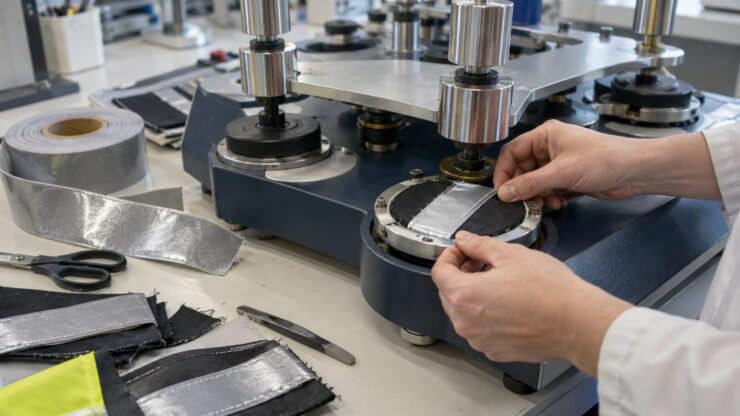
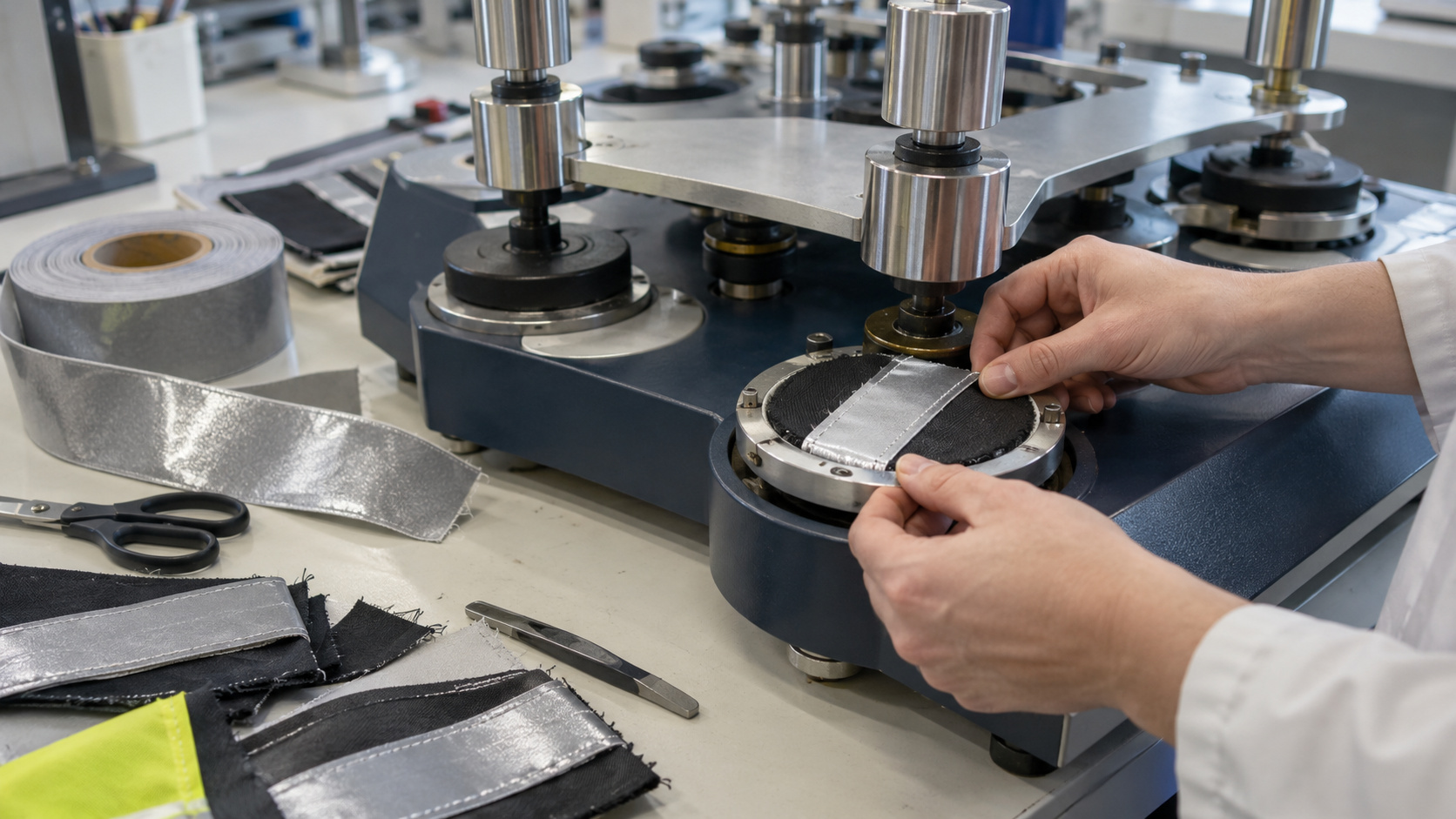
| Abrasion | Yes | Yes | Martindale, EN ISO 12947-2, wool abradant, 9 kPa, 5,000 cycles |
| Folding at cold temperature | Yes | Yes | ISO 4675 at −20 °C; no cracking or loss of surface material |
| Temperature variation | Yes | Yes | 12 h at 50 °C, then 20 h at −30 °C, then reconditioning |
| Rainfall | Yes | Yes | Method of EN ISO 20471 |
| Washing | Not applicable | Yes | According to the manufacturer’s care instructions |
| Dry cleaning | Not applicable | Yes | According to the manufacturer’s care instructions |
Each specimen is conditioned for at least 24 hours at 20 °C and 65 % relative humidity before testing.
5. Cleaning cycles and the care label
Cleaning claims directly set the test burden. If the care information states a maximum number of cleaning cycles, the retroreflective material must still exceed the post-exposure minimum after that many cycles. If no number is stated, testing is carried out after five cycles. If the product is single-use and cleaning is not allowed, testing is done on new material only.
The marked wash count must relate to the visibility component with the lowest number of washes. If the fluorescent fabric survives 50 washes but the tape only 25, the label says 25.
For laundering of retroreflective material, the laboratory can use a 300 × 250 mm carrier fabric with two 250 × 50 mm stripes of tape, 50 mm apart, instead of a complete garment.
6. What to ask your tape supplier
- Is the material separate-performance or combined-performance?
- Full photometric table results for new material at both rotation angles.
- Post-exposure results for abrasion, cold folding, temperature variation and rainfall.
- Post-wash results at the number of cycles you intend to claim, using the same wash method as your care label.
- Whether the material is orientation sensitive, and how the datum is marked.
- Whether printed versions of the tape were tested on the lowest-performing segment.
A material report is a strong starting point, but the finished product assessment still needs to cover the actual tape construction, stitching, printing and care instructions.
FAQ
Is 330 cd/(lx·m²) the same requirement as EN ISO 20471?
The new-material value at 12′/5° matches the figure EN ISO 20471 sets for new separate-performance retroreflective material. The area requirements, design rules and risk levels differ, so a tape suitable for one standard still has to be checked against the other.
Does heat-transfer film need the same tests as sewn tape?
Yes. The requirements apply to the retroreflective material as used on the product, however it is attached. Heat-transfer film is often more sensitive to washing and abrasion, so its post-exposure data deserves extra attention.
What if the material fails only after washing?
Reduce the wash count claimed on the label, change the care method, or choose a more durable material. The claimed wash count and the test results must match.
Conclusion
For EN 17353 reflective tape, the new-material number gets attention, but the post-exposure number decides whether the product stays compliant through its life. Choose the right material category, test at both orientations, plan the care label around real wash data, and keep the tested construction identical in production.
This article provides general technical information, not a product-specific conformity assessment or legal opinion. Consult the current standard and the responsible laboratory or conformity-assessment body for the actual product and intended use.