


Importers of reflective accessories and garments often assume that if a product looks reflective, it will clear customs without issues. In practice, EU customs authorities focus on whether the product is correctly certified as Personal Protective Equipment (PPE). For medium-risk visibility equipment, the relevant harmonised standard is EN 17353:2020+A1:2025. Getting the documentation right before shipping saves weeks of delay and storage costs.
Why EN 17353 Compliance Matters for Customs Clearance
Under Regulation (EU) 2016/425, any product presented as improving the visibility of the wearer is treated as PPE. EN 17353 is the harmonised standard for enhanced visibility equipment intended for medium-risk situations — cycling, jogging, walking, or working near slow-moving vehicles. If your goods claim to meet this standard, customs officers may ask for proof that they have been assessed against the correct requirements.
Many importers still carry certificates for EN 1150:1999 (non-professional visibility clothing) or EN 13356:2001 (non-professional visibility accessories). Those standards have been withdrawn and replaced by EN 17353:2020. In our experience, presenting an old EN 1150 or EN 13356 certificate is one of the quickest ways to get a shipment flagged. The current standard is EN 17353:2020+A1:2025.
German buyers often see the designation DIN EN 17353, and Spanish buyers see UNE-EN 17353. These are national adoptions of the same European standard. A test report issued against EN 17353 is generally accepted across the EU; customs officials in member states expect the EN reference, but national prefixes should not create a problem if the certificate clearly identifies the EN number.
For a detailed explanation of the standard’s scope and requirements, see our comprehensive guide to EN 17353:2020+A1:2025.
EN 17353 as Category II PPE: Documentation Requirements
EN 17353 products are classified as Category II PPE under Regulation (EU) 2016/425. Category II PPE requires an EU type-examination by a Notified Body before the product can be placed on the market. This means the manufacturer must submit samples and technical documentation to a Notified Body, receive a type-examination certificate, and then draw up an EU Declaration of Conformity. Only after that can the CE mark be affixed.
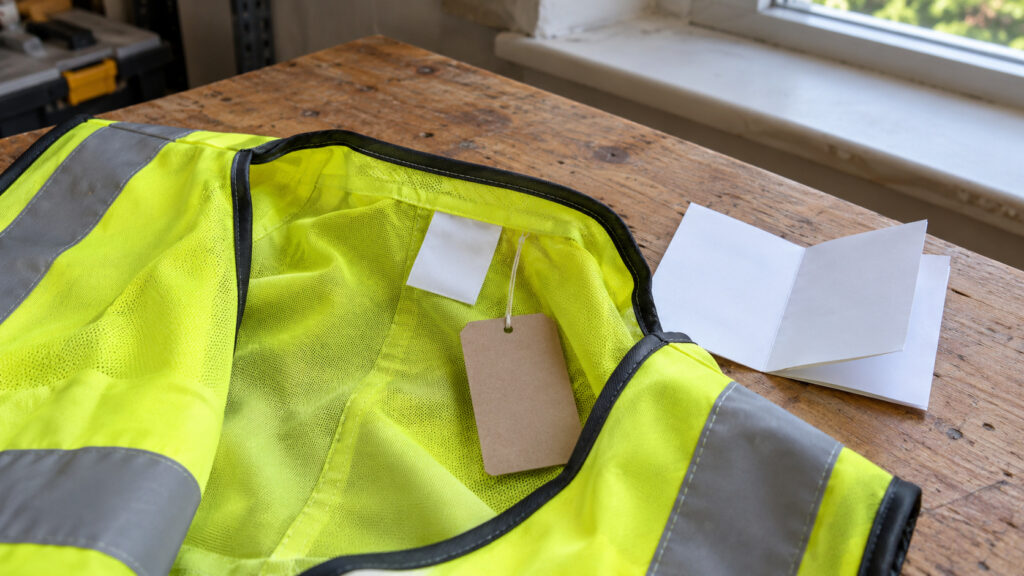
For customs clearance, you should have the following documents ready:
- Commercial invoice and packing list with accurate product descriptions, including EN 17353 type (A, B1, B2, B3, AB2, AB3) if applicable.
- EU Declaration of Conformity signed by the manufacturer or authorised representative, referencing EN 17353:2020+A1:2025 and the Notified Body certificate number.
- Notified Body type-examination certificate (or a copy) showing the product model and EN 17353 type covered.
- Test reports showing compliance with the standard’s performance requirements (retroreflection, colour, etc.).
- Technical file (not always submitted, but must be available on request; it should include design drawings, risk assessment, and test data).
- Product label and user instructions in the language of the destination country.
If you are an importer or distributor, you are not required to hold the technical file yourself, but you must be able to obtain it from the manufacturer and present it to authorities. We recommend keeping digital copies of all documents linked to the shipment.
Understanding the EN 17353 Equipment Types (A, B, and AB)
EN 17353 defines three main equipment types based on how visibility is achieved:
- Type A: uses only fluorescent materials. It provides visibility during daylight and twilight, but not in darkness.
- Type B: uses only retroreflective materials. It provides visibility in the dark when illuminated by vehicle headlights. Type B is divided into three subcategories:
- B1: free-hanging devices (e.g., reflective pendants, tags).
- B2: devices worn on limbs (e.g., arm bands, slap wraps).
- B3: materials on the torso or torso and limbs (e.g., belts, harnesses).
- Type AB: combines fluorescent and retroreflective materials, giving visibility in daylight, twilight, and dark conditions.
Equipment with active lighting, such as LED strips, is not covered by EN 17353. High-visibility garments for high-risk professional use near traffic fall under EN ISO 20471 instead. Many buyers want both standards in one design, but the tests and area requirements are different. For a detailed comparison, see EN ISO 20471 vs EN 17353.
In our experience, buyers often ask for a side-by-side comparison to decide which standard fits their product. We summarise the key differences as follows:
| Parameter | EN 17353 | EN ISO 20471 |
|---|---|---|
| Risk level | Medium (cycling, running, pedestrians, slow vehicles) | High (professional work near traffic) |
| Allowed fluorescent colours | Specified colours (yellow-green, yellow, yellow-orange, orange, orange-red, red, pink) | Specified colours (yellow, orange-red, red) |
| Adult fluorescent area (A/AB) | Ask our sales team for the minimum area required for your product | Class 1 (confirm the minimum area with our sales team), Class 2 (confirm the minimum area with our sales team), Class 3 (confirm the minimum area with our sales team) |
| Adult retroreflective area | Type B3/AB3: confirm the minimum area with our sales team; Type AB2: confirm the minimum area with our sales team | Class 1 (confirm the minimum area with our sales team), Class 2 (confirm the minimum area with our sales team), Class 3 (confirm the minimum area with our sales team) |
| Design | Includes B1 pendants and B2 limb devices; no mandatory torso encircling | Requires encircling band design |
| Children | Specific requirements for height ≤ the threshold defined in the standard (confirm the applicable height limit with our sales team) | No equivalent specific children’s classes |
Retailers and promotional product buyers often prefer EN 17353 because it allows more colours and lower area requirements, which are better suited to consumer and children’s products.
Avoiding Customs Delays: Common CE Marking Mistakes
Even with a valid EN 17353 certificate, shipments can be held if the marking or paperwork does not match. Here are the most frequent issues seen when helping buyers troubleshoot customs holds:
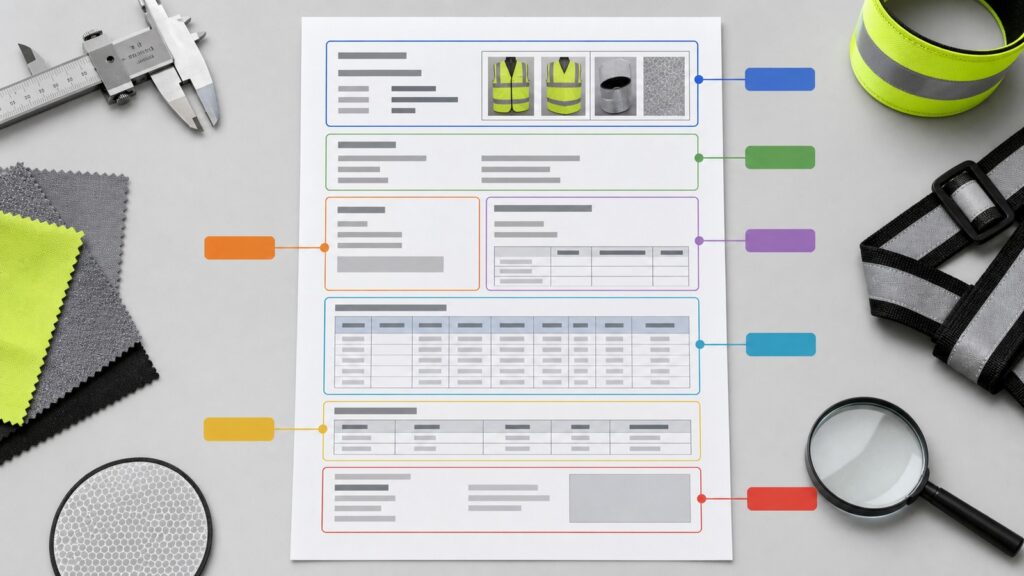
- Missing Notified Body identification number. For Category II PPE, the CE mark must be followed by the identification number of the Notified Body that performed the EU type-examination. A lonely “CE” logo without the number is a red flag.
- Old standard references. Documents citing EN 1150 or EN 13356 are out of date and will not be accepted.
- Mismatched product details. The certificate model name, sizes, or type must exactly match the goods in the container. A certificate for “Type B2 slap band” does not cover a different design or a B3 harness.
- No EU Declaration of Conformity. Some suppliers send only the test report and forget the DoC. Both are needed.
- User instructions missing or not in local language. The PPE Regulation requires information in the language of the destination member state.
- Wrong risk category. If the product is intended for professional high-risk use, it must comply with EN ISO 20471, not EN 17353. Attempting to pass a high-risk garment as EN 17353 medium-risk can lead to rejection.
Before shipping, ask your supplier to send photographs of the actual marking on each product, the label, and a copy of the Notified Body certificate. Cross-check the certificate number with the Declaration of Conformity.
Sourcing Compliant Reflective Accessories and Garments
When you source EN 17353 products, the supplier should be able to provide the Notified Body certificate for the exact product you are buying. Do not accept a certificate that covers a “similar” product. The certificate must state the EN 17353 type: B1, B2, B3, AB2, AB3, or A.
At Yuyao Kean Reflective Products Co., Ltd., we hold valid EN 17353 certificates for four product lines: Type B1 soft reflective pendants, Type B2 slap bands, Type B2 elastic arm bands, and a children’s harness. We use high-quality reflective materials, primarily 3M Scotchlite and Reflexite, but the certificate covers the finished product, not just the material.
When requesting a quotation, ask for:
- The EN 17353 certificate or type-examination report for that specific model.
- Confirmation that the product is Category II PPE and has a Notified Body number.
- A sample of the user instructions and the marking layout.
For products aimed at children, also check the 140 cm height rule for children’s garments and the specific area requirements for AB3 safety vests. For arm bands and slap wraps, see our detailed guide on EN 17353 Type B2.
FAQ
What documentation is required for EN 17353 customs clearance?
You will need the commercial invoice, packing list, EU Declaration of Conformity, Notified Body type-examination certificate, test reports, and the technical file if requested. The product must also bear the CE mark with the Notified Body identification number, and user instructions must be provided in the destination language.
What is the difference between EN 17353 and EN ISO 20471?
EN 17353 is for medium-risk visibility equipment used by consumers, sports enthusiasts, and workers near slow vehicles. It allows more fluorescent colours, lower area requirements, and includes accessories like pendants and limb bands. EN ISO 20471 is for high-risk professional use near traffic and has stricter area, design, and colour requirements.
What is EN 17353 Type B2?
Type B2 covers retroreflective devices worn on limbs, such as arm bands, slap wraps, and ankle bands. They are designed to be visible at night when illuminated by headlights. Type B2 products must meet minimum retroreflective area and performance requirements.
What is EN 17353 Type B3?
Type B3 covers retroreflective materials placed on the torso or on the torso and limbs. Examples include reflective belts, cross-body straps, and harnesses. The required retroreflective area is larger than for limb devices.
Disclaimer: This article is for guidance purposes only. The official EN 17353:2020+A1:2025 standard text prevails.