
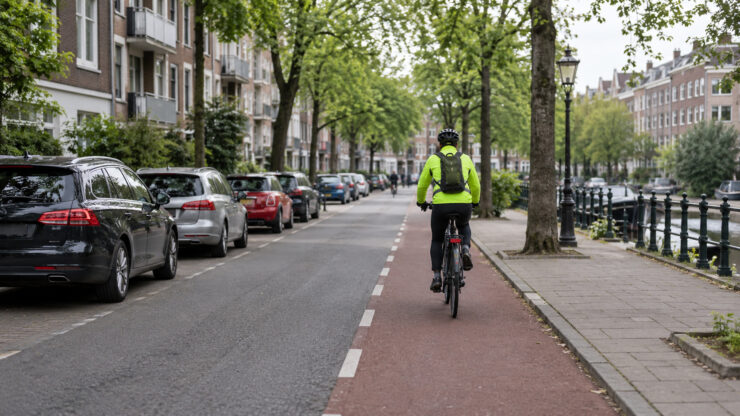
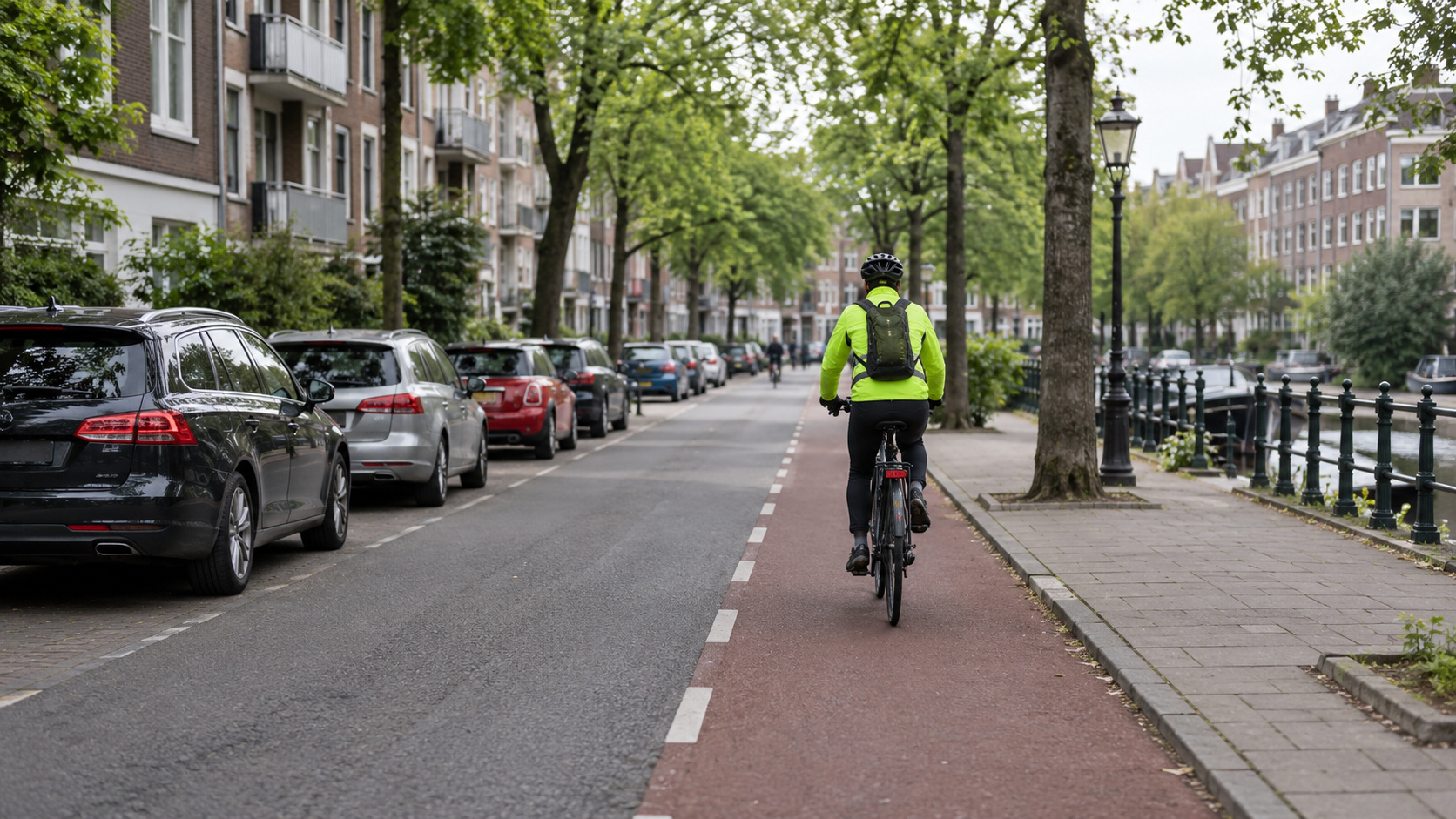
EN 17353 Type A is the daylight-only class of enhanced visibility equipment: it relies on fluorescent material alone, with no retroreflective component. It suits products such as fluorescent T-shirts, running tops, vests, tabards and trousers worn where the risk of not being seen exists in daylight, but not after dark.
Type A looks like the simplest class in the standard, yet many samples fail on two points that have nothing to do with the fabric itself: the total fluorescent area measured on the smallest size, and how that area is distributed around the body. This guide walks through both, based on EN 17353:2020+A1:2025.
Type A requirements at a glance
| Main point | Practical requirement |
|---|---|
| Lighting condition | Daylight only |
| Visibility component | Fluorescent material only |
| Minimum fluorescent area, user height up to 140 cm | 0.14 m² |
| Minimum fluorescent area, user height above 140 cm | 0.24 m² |
| Front and back | Each carries at least 40 % of the minimum required area |
| Left and right sides | Each carries at least 10 % of the minimum required area |
| Material tests | Colour and luminance, colour after Xenon exposure, colour fastness |
| Marking | The daylight pictogram for Type A |
1. When Type A is the right class
EN 17353 groups equipment by the conditions in which the wearer needs to be seen. Type A answers a daylight risk only. If the product is expected to be worn at dusk, at night or in poor light under vehicle headlights, Type A is not enough: the product needs a retroreflective component and should be developed as Type B or Type AB instead.
That decision belongs in the product brief before sampling starts. A fluorescent cycling jersey sold for daytime rides can be a Type A product. The same jersey marketed for winter commuting, when much of the journey is in the dark, points towards Type AB.
Type A is also not a substitute for EN ISO 20471. EN 17353 covers medium-risk situations. Workers exposed to fast traffic in a high-risk setting remain within the scope of EN ISO 20471.
2. Measure the area on the smallest size
The minimum area is not checked on the sample size the factory happens to send. It is measured on the smallest garment size intended to be supplied, separately for each of the two height ranges, with every fastener set to its tightest configuration and the garment lying flat.
In practice this means:
- A size range that covers both children and adults has two smallest sizes to check: the smallest size up to 140 cm user height and the smallest size above 140 cm.
- Adjustable side straps, drawcords and hook-and-loop tabs must be closed to the smallest setting before measuring.
- Areas hidden under logos, lettering, labels or prints do not count. Measure what remains visible.
If a size chart straddles the 140 cm line, for example a size intended for users from 138 cm to 142 cm, the higher requirement of 0.24 m² applies to that size.
3. Visibility from all sides: the 40 / 10 rule
A garment can have enough fluorescent area in total and still fail because the area is concentrated in one place. Type A requires fluorescent material on all sides so the wearer is visible through 360°.
The check works on the minimum required area, not on the actual area of the garment:
- Lay the garment flat on its back and measure the front. At least 40 % of the minimum required area must be visible.
- Turn it over and measure the back. Again, at least 40 %.
- For each side view, the left side and the right side must each show at least 10 % of the minimum required area.
Worked example. An adult-size top must carry 0.24 m². Front and back each need at least 0.096 m² of visible fluorescent material, and the left and right sides each need at least 0.024 m². A top with a large fluorescent front panel and a dark back panel fails, even if the front alone exceeds 0.24 m².
For upper-body garments, the fluorescent material should be spread evenly around the torso, upper arms or limbs. For lower-body garments such as trousers, it should be spread evenly around the legs.
4. Keep the fluorescent areas solid
The standard notes that conspicuity comes from well-defined fluorescent areas. Fragmented patterns, fine stripes, camouflage-style prints and heavy all-over graphics are poor choices, even when the area calculation looks acceptable on paper. Large, clean blocks of fluorescent colour on the shoulders, chest, back and sides perform better and are easier to measure.
Partial body garments are within scope too. Sleeves, aprons and chaps can be Type A products if they meet the same area and distribution rules.
5. Material tests for the fluorescent fabric
The fluorescent material has to prove its colour, both new and after ageing:
- Colour and luminance factor. The new material must fall within one of the fluorescent colour boxes defined in the standard and reach that colour’s minimum luminance factor.
- Colour after Xenon exposure. After artificial light exposure, the colour must still sit in a valid colour box and meet that box’s luminance minimum.
- Colour fastness. Rubbing (dry), perspiration and, according to the care label, laundering, dry cleaning, hypochlorite bleaching and hot pressing. Most results must reach grade 4 or better on the grey scale.
- Dimensional change. Assessed according to EN ISO 13688.
If the care label allows a stated number of cleaning cycles, the colour requirements must still be met after that number of cycles. Without a stated number, testing is done after five cycles.
6. Marking and user information
Type A garments follow the general marking and information rules of EN ISO 13688 and carry the Type A daylight pictogram. Where a maximum number of cleaning cycles is claimed, it is marked close to the pictogram. The user information should also warn that adding logos or prints can reduce the visible area and compromise performance.
Type A design checklist
- Confirm the product is only intended for daylight use.
- Identify the smallest size in each height range you will sell.
- Measure flat, fasteners at their tightest, logos excluded.
- Check 0.14 m² or 0.24 m² as applicable.
- Check 40 % front, 40 % back, 10 % each side.
- Use large, continuous fluorescent areas.
- Test colour, Xenon colour and colour fastness on the production fabric.
- Prepare the pictogram, care label and user information.
FAQ
Can a Type A garment have reflective trim?
Reflective trim can be added as extra material, but it does not make the garment Type B or Type AB unless the retroreflective part is designed, measured and tested to those requirements. Do not market night-time visibility on the basis of decorative piping.
Does the 40 % rule use the actual area or the minimum area?
The minimum required area. For an adult garment, 40 % of 0.24 m² is 0.096 m², regardless of how much fluorescent material the garment actually carries.
Which fluorescent colours are allowed?
EN 17353 allows more colours than EN ISO 20471: yellow-green, yellow, yellow-orange, orange, orange-red, red and pink, each within its own chromaticity box and luminance limit.
Conclusion
EN 17353 Type A rewards early design discipline. Decide that the product is daylight-only, measure the smallest size in each height range, and place enough fluorescent material on every side of the body. Fabric that passes the colour tests is only half the job; the garment pattern decides whether the product passes the area and visibility checks.
This article provides general technical information, not a product-specific conformity assessment or legal opinion. Consult the current standard and the responsible laboratory or conformity-assessment body for the actual product and intended use.