
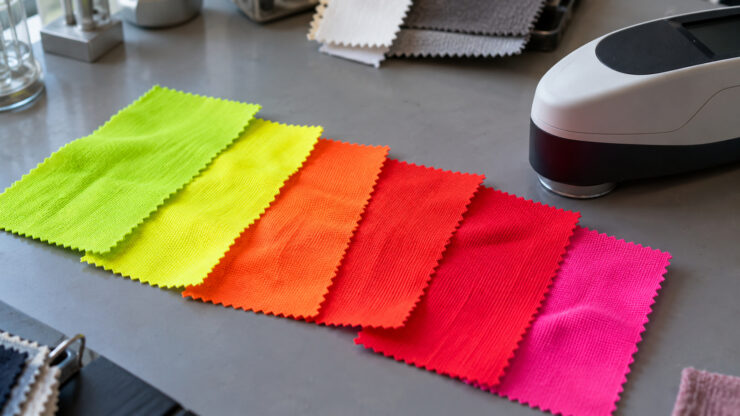
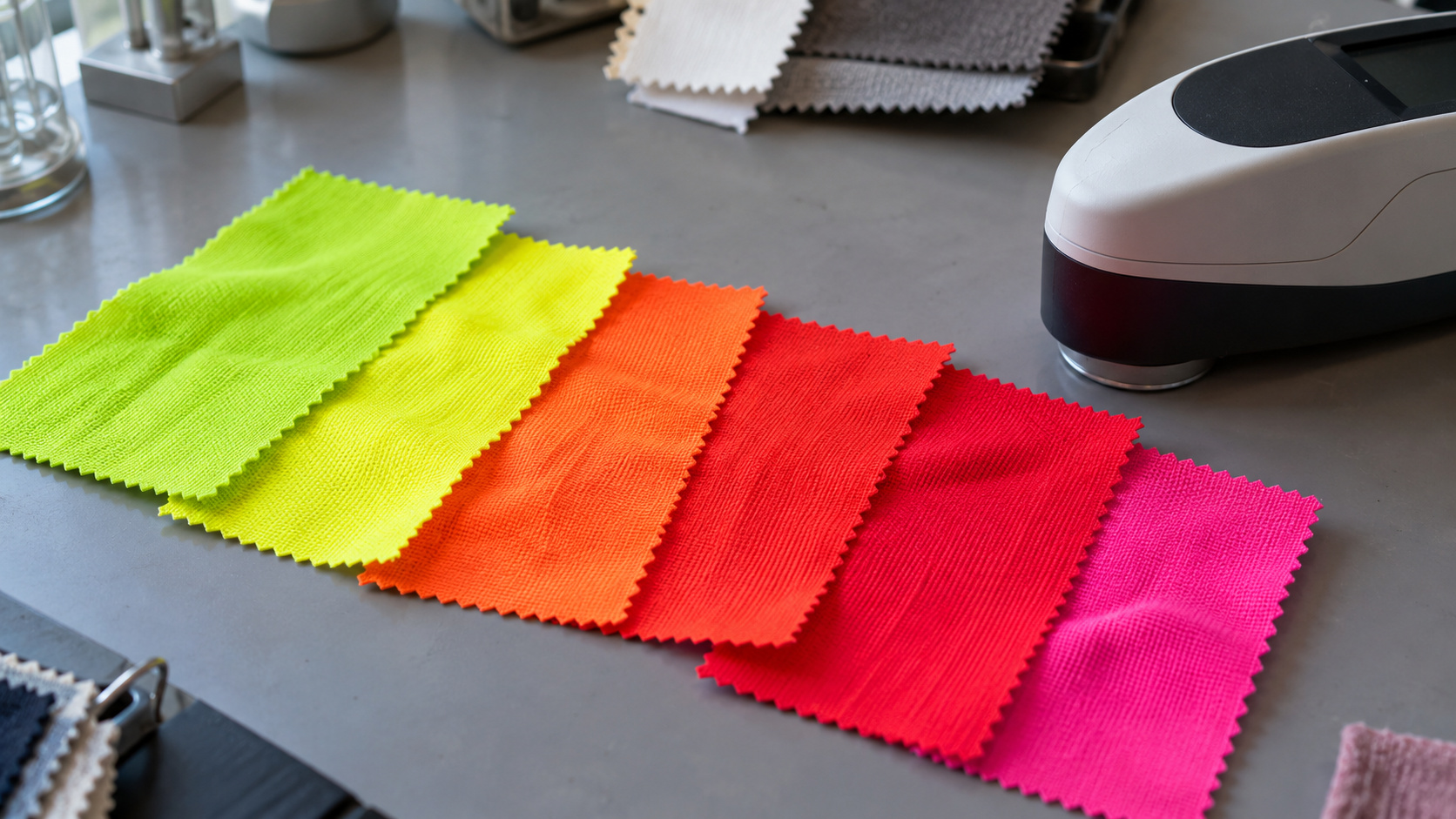
EN 17353 allows seven fluorescent colours, from yellow-green to pink, and each one has its own colour box and minimum luminance factor. That freedom is one of the main differences from EN ISO 20471, but it comes with a rule many developers overlook: after light exposure, a colour may drift into a neighbouring box, and the product then has to meet the requirements of the colour it has become.
This guide explains how the colour requirements work in EN 17353:2020+A1:2025, for fluorescent fabrics used in Type A and Type AB products and for combined-performance materials.
The seven fluorescent colours at a glance
| Colour | Minimum luminance factor, fluorescent material | Minimum luminance factor, combined-performance material |
|---|---|---|
| Fluorescent yellow-green | 0.5 | 0.4 |
| Fluorescent yellow | 0.7 | 0.7 |
| Fluorescent yellow-orange | 0.6 | 0.5 |
| Fluorescent orange | 0.5 | 0.4 |
| Fluorescent orange-red | 0.4 | 0.4 |
| Fluorescent red | 0.25 | 0.25 |
| Fluorescent pink | 0.3 | 0.3 |
Each colour is also defined by four chromaticity corner points on the CIE 1931 diagram. The material’s measured x, y coordinates must fall inside the box, and its luminance factor must reach at least the value above. Use the chromaticity coordinates in the standard itself when setting fabric specifications.
1. How colour is measured
The measurement follows CIE 015 colorimetry with a few practical conditions that are worth stating in your purchase specification:
- Illuminant D65 and the 2° standard observer.
- 45/0 illuminating and viewing geometry.
- One layer of the material, including any backing or lining that forms part of the construction.
- A black underlay with reflectance below 0.04.
- At least four readings in four perpendicular directions, averaged. An annular or circumferential instrument can use a single reading.
Specifying the same geometry and backing when you approve mill samples avoids disputes later, when the laboratory measures under the standard’s conditions and gets a different result.
2. Colour after Xenon exposure
Fluorescent dyes fade under light. EN 17353 therefore checks the colour again after Xenon arc exposure according to EN ISO 105-B02, method 3. The exposure length depends on the colour family:
- Red and orange-red: exposure continues until blue wool reference 5 has faded to grade 3 on the grey scale.
- Yellow-green, yellow, yellow-orange, orange and pink: exposure continues until blue wool reference 4 has faded to grade 4.
After exposure, the material must still sit inside one of the defined colour boxes, and its luminance factor must meet the minimum of the box it now falls into.
3. When a colour moves to another box
This is the part of the colour clause that surprises people. A shift between boxes is not automatically a failure. A fluorescent red that drifts into the orange-red box after Xenon exposure can still pass, provided its luminance factor is higher than the orange-red minimum of 0.4.
Two consequences follow:
- The luminance target changes. Red has a low minimum of 0.25, but orange-red requires 0.4. A red fabric that drifts must clear the higher bar.
- The user information must say so. If the colour changes from one box to another after the Xenon test, this has to be stated in the instructions for use.
For product teams, the practical lesson is to review Xenon data before finalising the colour name used in catalogues and labels, so the marketing colour and the instructions tell the same story.
4. Colour fastness requirements
For Type A and Type AB equipment, the fluorescent material and every non-fluorescent textile layer must also pass colour fastness tests. In summary:
| Test | Method | Typical minimum grade |
|---|---|---|
| Rubbing, dry | EN ISO 105-X12 | 4 for staining |
| Perspiration | EN ISO 105-E04 | 4 for colour change of fluorescent material, 4 for staining |
| Laundering | EN ISO 105-C06 | 4–5 for colour change, 4 for staining |
| Dry cleaning | EN ISO 105-D01 | 4 for colour change, 4 for staining |
| Hypochlorite bleaching | EN 20105-N01 | 4 for colour change |
| Hot pressing | EN ISO 105-X11 | 4–5 for colour change, 4 for staining |
Laundering, dry cleaning, bleaching and pressing tests follow the garment’s care label. If the label forbids bleaching, the bleaching test is not relevant. If the label allows it, the fabric must pass.
5. Choosing a colour for your product
The wider colour range is an opportunity for consumer products such as children’s wear, running gear and pet-owner accessories, where buyers want something other than safety yellow. A few practical points help:
- Yellow has the highest luminance requirement, 0.7, so a dull yellow fabric may fail even if it looks bright to the eye.
- Red and pink have lower luminance minimums but are more prone to fading and box shifts. Ask the mill for Xenon data before bulk production.
- Combined-performance material, which is both fluorescent and retroreflective, has slightly lower luminance minimums for several colours. Check the right column when you approve it.
- Measure the finished construction. A lining, laminate or coating can change the measured colour.
FAQ
Can I use any colour for an EN 17353 product?
Only the fluorescent material must fall within one of the seven defined colours. Non-fluorescent parts of the garment can be any colour, but they still need to pass the relevant colour fastness tests where the standard applies them.
Are the EN 17353 colours the same as EN ISO 20471?
No. EN ISO 20471 allows fluorescent yellow, orange-red and red. EN 17353 adds yellow-green, yellow-orange, orange and pink, giving designers a much wider range for medium-risk products.
Does a Type B product need to meet the colour requirements?
Type B relies on retroreflective material, so the fluorescent colour tables do not apply to it. The colour fastness clauses are applied to Type A and Type AB equipment.
Conclusion
Colour is where EN 17353 gives designers the most freedom, but the requirements are precise. Pick a colour box, check luminance on the finished construction, get Xenon data early, and plan the user information in case the colour shifts. A fabric that looks right in the showroom must still be measured right in the laboratory.
This article provides general technical information, not a product-specific conformity assessment or legal opinion. Consult the current standard and the responsible laboratory or conformity-assessment body for the actual product and intended use.