
An EN 17353 test report should prove that the product you are buying—not just a similar reflective material—was assessed for the correct visibility type and test scope. Before accepting a supplier’s “Pass” page, match the report to the product, then check the design, minimum area, photometric results, pre-treatments, and report identity.
This guide shows procurement teams, importers, and PPE product managers what to look for. It draws on EN 17353:2020, the A1:2025 amendment, and real Type B1, B2, and B3 laboratory reports reviewed for this article.
EN 17353 sits within the European PPE conformity framework; buyers can confirm the legal context through the EU’s harmonised PPE standards decision and Regulation (EU) 2016/425.
Quick summary: the six checks that matter most
- Product identity: the sample description, model, colour, construction, and photographs should match the goods being ordered.
- Correct standard and edition: the report should state the applied standard clearly, including relevant amendments where applicable.
- Correct EN 17353 type: Type B1, B2, and B3 have different designs and test routes.
- Complete scope: a photometric test alone does not demonstrate compliance with every product requirement.
- Traceable results: the detailed pages should show methods, specimens, measured results, requirements, and conclusions—not only a one-page “Pass” summary.
- Authenticity and applicability: verify the report with the issuing laboratory and confirm that changes to materials, dimensions, printing, or suppliers have not made it irrelevant.
Start with product identity, not the Pass column
The first question is simple: was this exact product tested? A valid-looking report for a reflective tape does not automatically cover a finished armband, harness, or hanging device made with that tape.
Compare the report with your purchase specification and pre-production sample. Check the applicant and manufacturer, sample description, model or style number, colour, size range, material references, photographs, and sample-receipt date. If the product has multiple colours or constructions, confirm which variants were included.
Small differences can change the assessment. A wider armband may satisfy an area rule that a narrower version misses. A logo can reduce usable retroreflective area. Changing the reflective material supplier may alter photometric performance. If the tested model and production model cannot be linked, the report has limited value for the shipment you are buying.
Confirm the EN 17353 product type and intended use
An EN 17353 test report should identify the product type because the standard does not treat all reflective products alike.
| Product type | Typical product form | What the buyer should expect the report to address |
|---|---|---|
| Type B1 | Free-hanging retroreflective device | Finished-device construction, active area on both sides, attachment and Type B1 luminous-intensity testing |
| Type B2 | Device or material positioned on limbs | Minimum area, limb placement, 360° visibility, band/design dimensions and material retroreflection |
| Type B3 | Material positioned on torso, or torso and limbs | Minimum area for the stated user height, front/back distribution, torso or limb placement and material retroreflection |
This is more than a label. A Type B1 report cannot be used as evidence for a Type B2 armband, and a Type B2 slap wrap is not automatically evidence for a Type B3 harness. The sample, intended wearing position, design clauses, and photometric route must agree.
For a fuller explanation of the categories, see EN 17353 types and minimum area requirements.
Check whether the test scope covers the finished product
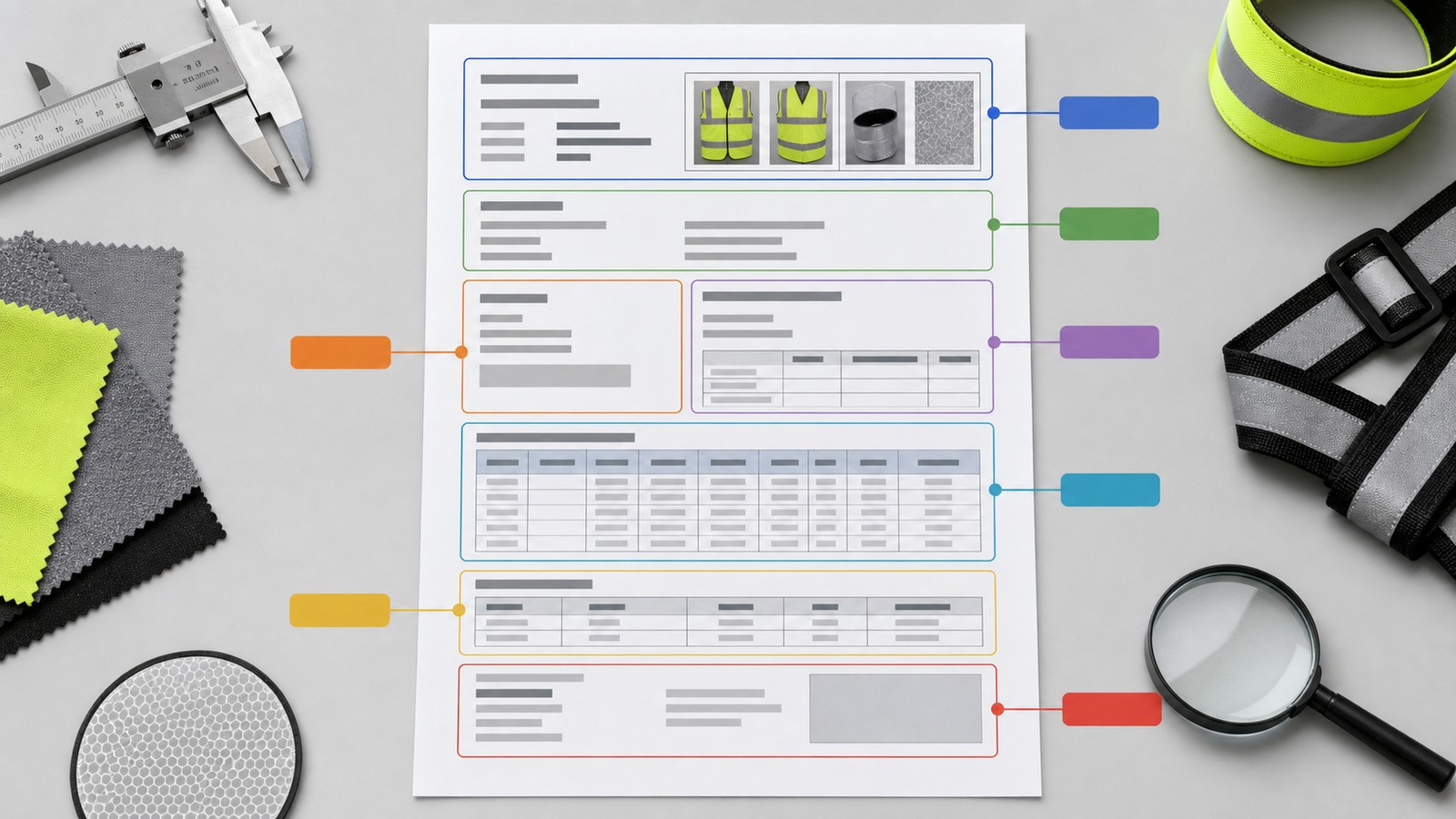
A one-page conclusion table is useful for orientation, but it is not enough on its own. Read the test-parameter list and the detailed result pages.
In the reports reviewed for this guide, the scope varied by product. The Type B1 hanging reflector report focused on new-material photometric performance plus cold folding, temperature variation, and rainfall exposures. Type B2 and B3 product reports also covered design and minimum-area requirements, while some included general protective-clothing checks such as design, comfort, size designation, pH, and azo dyes.
That variation is expected because the appropriate programme depends on the product and its claimed use. It also explains why buyers should not ask only, “Does it have an EN 17353 report?” The better question is, “Does this report cover every applicable requirement for this exact finished product?”
Read design and minimum-area results separately from brightness
Bright reflective material cannot rescue a design that places too little material in the wrong position. EN 17353 contains separate requirements for material area, placement, visibility from the required directions, and photometric performance.
For a Type B2 reflective armband, for example, the report should connect the measured area and construction to the limb-placement rules. For Type B3 torso equipment, it should address the applicable user-height range and the distribution of retroreflective material. A Type B1 free-hanging device has its own geometry, area, two-sided reflection, and attachment requirements.
Look for actual measurements or an unambiguous design assessment. If the report says only that a fabric reached a coefficient value, it may support the material choice but not the full product claim. Our EN 17353 test methods overview explains why design and laboratory performance have to be considered together.
Understand the photometric tables and pre-treatment results
Photometric pages should identify the applicable method, measurement geometry, specimens, required threshold, measured result, and conclusion. Type B1 finished devices and retroreflective materials used for Type B2/B3 are not necessarily reported with the same photometric quantity, so compare results only within the correct test route.
Also check what happened before the final measurement. Depending on the product and material, the report may include abrasion, folding at cold temperatures, temperature variation, rainfall, free fall, water immersion, washing, or another applicable exposure. A strong result on new material does not replace the required after-exposure assessment.
Orientation matters too. Some retroreflective materials perform differently when rotated. The report should make clear how orientation-sensitive material was assessed and whether the lowest relevant result still met the requirement.
Look for evidence of sample development and production control
A failed first sample is not automatically a red flag. It can show that testing found a real design or material problem and that the manufacturer submitted an improved sample. Two reports reviewed for this article explicitly identify the tested item as an improvement sample after an earlier failure.
The important question is whether production now matches the successful sample. Ask what changed, record the approved bill of materials and dimensions, and add those points to incoming inspection. Without change control, a later shipment can drift back to the construction that failed.
Testing is therefore one part of compliance, not the whole quality system. A buyer should connect the report to an approved sample, technical file, supplier controls, and repeatable production specification.
Verify the laboratory, report identity, and certificate relationship
Treat authenticity as a separate check. Record the report number, issue date, page count, laboratory name, contact details, signatures or electronic validation, and any accreditation marks or limitations stated in the report. Then verify the document using contact details obtained independently from the laboratory’s official website—not only the email printed on a PDF supplied by a seller.
Do not confuse a test report with an EU type-examination certificate. The report records examinations and results. A certificate, where required by the conformity-assessment route, identifies the approved PPE type and the basis of the notified body’s decision. The model and technical documentation should connect the two.
Our article on EU type-examination Module B explains the role of the certificate. Buyers should review the report, certificate, Declaration of Conformity, marking, user information, and product as one evidence set.
Red flags when reviewing an EN 17353 test report
Pause the order or request clarification when you find any of these problems:
- the model number or product photograph does not match the offered item;
- only a material swatch was tested, but the supplier claims the finished product is compliant;
- the report names a different Type from the product’s actual wearing position;
- pages, tables, signatures, or report numbers are missing or inconsistent;
- the report shows only a summary conclusion and no measured results;
- artwork, material, width, size range, or construction changed after testing;
- the laboratory cannot confirm the report;
- the certificate and report refer to different models or manufacturers; or
- marketing claims exceed the intended use and protection described in the documentation.
One red flag does not always prove fraud, but it does mean the evidence is incomplete. Resolve the mismatch before shipment.
FAQ about EN 17353 test reports
Is a reflective-material report enough for an EN 17353 product?
Usually not. Material data can support part of the assessment, but the finished product may also need design, area, placement, attachment, marking, information, and product-specific performance checks.
Can one EN 17353 test report cover several models or colours?
It may cover a defined family when the laboratory and conformity assessment justify the variants. The report or technical documentation should show why the tested samples represent every claimed model. Do not assume coverage from visual similarity alone.
How recent must an EN 17353 test report be?
There is no useful universal “freshness” number for every purchasing decision. Check whether the standard, product, materials, factory, and technical documentation have changed since testing. A newer report can still be irrelevant, while an older report may remain useful if the approved product and legal basis are unchanged and the conformity route remains valid.
Does a Pass result mean every shipment is compliant?
No. It means the tested sample met the listed requirements under the stated conditions. Production control, material traceability, change management, and shipment inspection are needed to keep later goods consistent with that sample.
Should a buyer verify the report with the laboratory?
Yes, particularly for a new supplier, high-volume order, or document with inconsistencies. Use the laboratory’s independently obtained official contact channel and provide the report number without sending unnecessary confidential product data.
Conclusion
The best way to read an EN 17353 test report is to work from the product outward: verify the sample identity, confirm the correct Type, examine the complete scope, trace the measured results, and connect the document to production and conformity records. A “Pass” stamp is the end of the laboratory table, not the beginning of buyer due diligence.
Before approving an order, create a one-page report matrix that links each model to its report, certificate, Declaration of Conformity, material specification, and approved sample. That simple record makes later changes much easier to spot.
This article provides general technical information and is not a product-specific conformity assessment or legal opinion. The responsible laboratory and conformity-assessment body should confirm the applicable test programme for the actual product.