
Short answer: a reflective plush toy or soft bag charm is not automatically an EN 17353 product simply because it is made from reflective fabric. EN 17353 evaluates the design and tested performance of the finished visibility device. A conventional three-dimensional stuffed charm is normally very different from the flat, free-hanging device described for Type B1, and it should not be sold with an EN 17353 compliance claim unless the exact finished product has passed the applicable assessment.
This distinction matters because buyers often use the words reflective toy, reflective pendant, bag charm, and PPE reflector as if they described the same product. They do not. Product design, intended use, foreseeable use, testing, documentation, packaging, and marketing claims all affect the regulatory answer.
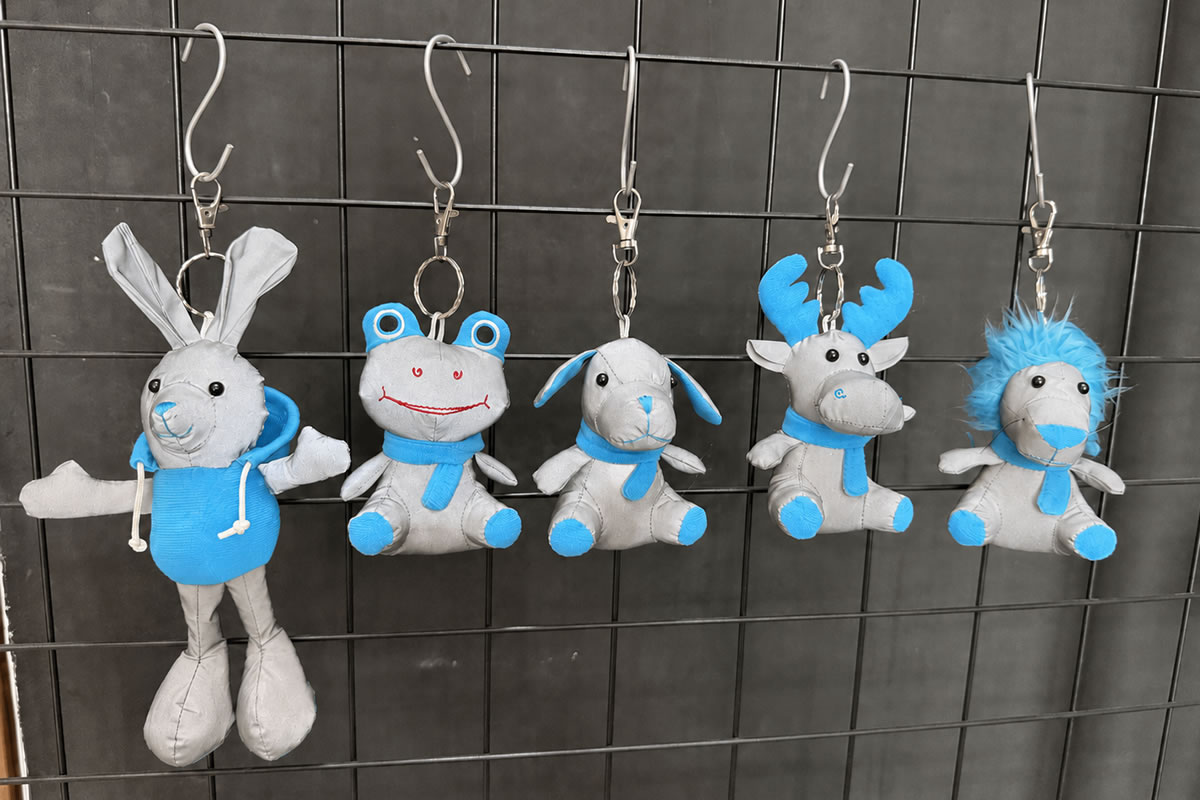
Why a conventional reflective plush charm is not an EN 17353 Type B1 device
EN 17353 covers enhanced-visibility clothing and devices for medium-risk situations. Type B1 is the category for free-hanging retroreflective devices. The standard does not say that every object hanging from a backpack becomes Type B1. The finished device has to satisfy a complete set of design, area, wearing, and photometric requirements.
For a Type B1 free-hanging device, the important design points include:
- the device is flat and has a maximum thickness of 10 mm;
- it is retroreflective on both sides;
- the optical active area is at least 15 cm² on each side, while the total area is limited;
- the attachment allows the device to hang and rotate as intended;
- the user information describes the correct wearing configuration, including the required placement for visibility; and
- the finished device passes the applicable luminous-intensity tests on both sides, including the required test exposures.
A soft stuffed animal charm is usually thicker than 10 mm and is not flat. Its face, seams, printed details, filling, and curved surfaces also reduce or interrupt the optical active area. Those facts make it fundamentally different from the Type B1 products described in EN 17353.
Reflective fabric is not proof of photometric compliance
A camera flash may make a fabric look very bright, but a flash photograph is not an EN 17353 test. Material specifications alone are also insufficient when the claim applies to the finished product.
The applicable EN 17353 evaluation considers defined observation and entrance angles and the relevant photometric quantity for the product type. It also considers the product after specified exposures. Printing, embroidery, seams, curvature, orientation, and decorative components can all change the effective reflective performance.
Therefore, the defensible conclusion is not that every reflective fabric is too dim. It is this: without a product-specific report covering the applicable EN 17353 requirements, a reflective-looking plush charm has no evidence for an EN 17353 claim. Learn more in our guide to the test methods of EN 17353.
Does calling it a “bag charm” mean EN 71 does not apply?
No—not by itself. This is an important compliance trap.
Under the EU Toy Safety Directive, a product can be a toy when it is designed or intended, whether exclusively or not, for play by children under 14. The European Commission’s grey-zone guidance even gives a key ring with a teddy bear attached as an example considered to be a toy. That means changing the invoice description from “reflective toy” to “bag accessory” does not automatically remove toy obligations.
Authorities look at objective and foreseeable factors, including:
- the animal or character design and its play value;
- the product’s size and softness;
- age grading, packaging, warnings, and sales channel;
- photographs showing children using or playing with it;
- advertising words such as “toy,” “for kids,” or “play”; and
- how consumers can reasonably be expected to use the product.
A genuinely decorative textile article aimed at adults may receive a different assessment, but the classification must be supported by the full product presentation. A “not a toy” statement cannot override an obviously child-appealing design and foreseeable play use.
The sewn loop and seam must be assessed under the correct EN 71-1 test
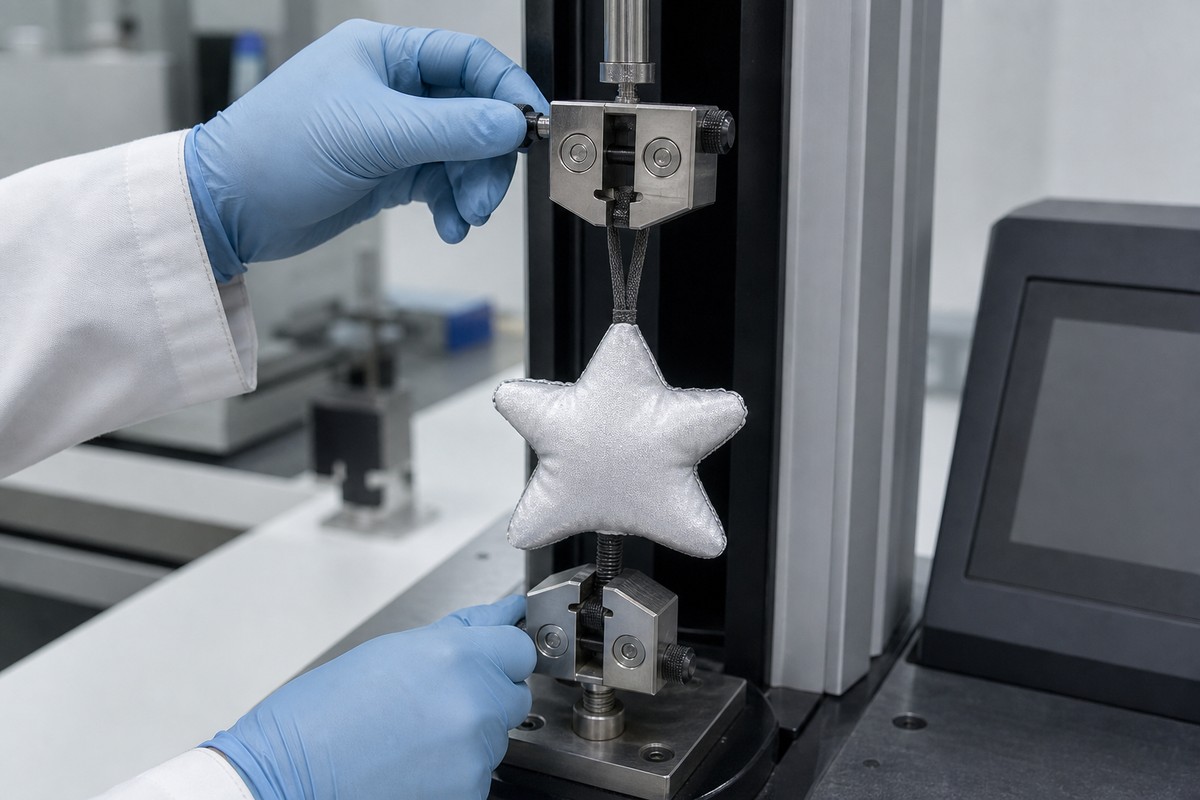
For a child-appealing plush charm, the connection between the hanging loop, head, and reflective outer fabric deserves particular attention. If stitching opens or a cord or decorative part detaches, filling or a small component may become accessible.
However, it is inaccurate to say that EN 71-1 always uses one universal pull force. The applicable procedure depends on the component and failure mode:
- a general graspable component may be tested at 50 N or 90 N depending on its dimensions and the applicable clause;
- a soft-filled toy seam and outer covering uses a different procedure, commonly associated with a 70 N force; and
- special components can have different requirements.
The test laboratory should inspect the real sample and decide whether it is evaluating seam opening, detachment of a graspable component, or another hazard. The acceptance decision also considers what becomes accessible after the test—not merely whether one stitch moves.
For current legal context, buyers can consult the European Commission’s toy-safety harmonised standards page and the Toy Safety Directive 2009/48/EC.
Toy, PPE, or decorative accessory: decide before production
The safest route is to decide the intended function at the design stage and keep every part of the product consistent with that decision.
| Commercial position | Main implication | Evidence needed |
|---|---|---|
| Enhanced-visibility PPE | A protective or visibility claim can bring the product into the PPE framework. | Applicable EN 17353 testing, conformity assessment, technical documentation, instructions, and correct marking. |
| Children’s toy or dual-use toy | Play value and foreseeable use can trigger toy-safety obligations even if the item also hangs from a bag. | Toy classification assessment and applicable EN 71 testing for the finished product. |
| Decorative bag accessory | No EN 17353 protective claim should be made. Toy status still has to be assessed from design and presentation. | Documented intended-use and classification rationale, general product-safety review, and market-specific checks. |
What about HS code 6304912900?
China tariff code 6304912900 may be considered for certain non-hand-worked knitted decorative articles, depending on their exact textile construction and use. It is not a universal code for every plush bag charm, and another destination market may use a different tariff line.
Most importantly, a customs code does not decide whether a product is a toy or PPE. Customs classification, product-safety classification, and PPE conformity are separate questions. Importers should confirm the code for the exact product and destination; for binding certainty in the EU, a Binding Tariff Information decision may be appropriate.
Buyer checklist for reflective plush charms
- Define the intended user, age group, and intended use.
- Review the product’s thickness, active reflective area, both sides, hanging construction, and visual claims.
- Do not treat a reflective-material data sheet as a finished-product EN 17353 report.
- If the design appeals to children, complete a documented toy-classification review.
- Ask a qualified laboratory to select the applicable EN 71-1 seam and component tests from the actual sample.
- Keep the product name, packaging, website images, warnings, test evidence, and customs declaration consistent.
- Never use EN 17353, CE, or “safety reflector” claims without the corresponding product-specific compliance evidence.
Final answer
A typical three-dimensional reflective plush charm should not be marketed as an EN 17353 Type B1 device. Its reflective appearance does not establish the required geometry or photometric performance. But calling it a bag accessory does not automatically make it “not a toy” either. The correct route depends on the product’s objective design, foreseeable use, marketing, test evidence, and destination market.
If you are sourcing or developing a reflective hanging product, begin with the intended regulatory category—not with the product name. That decision determines the design limits, tests, documentation, and claims that must follow.
This article provides general technical information and is not a product-specific conformity assessment, legal opinion, or customs ruling.