
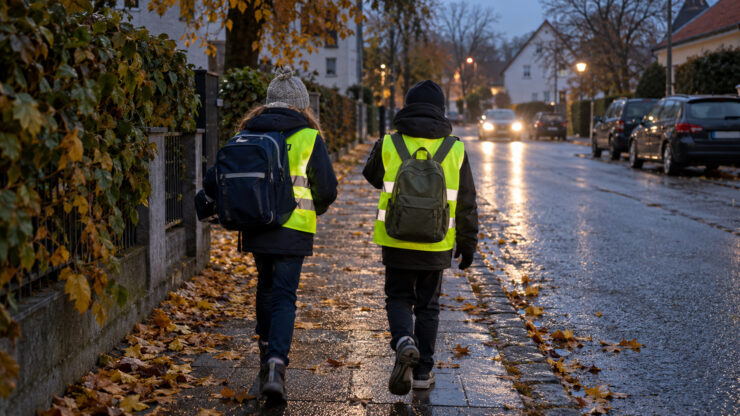
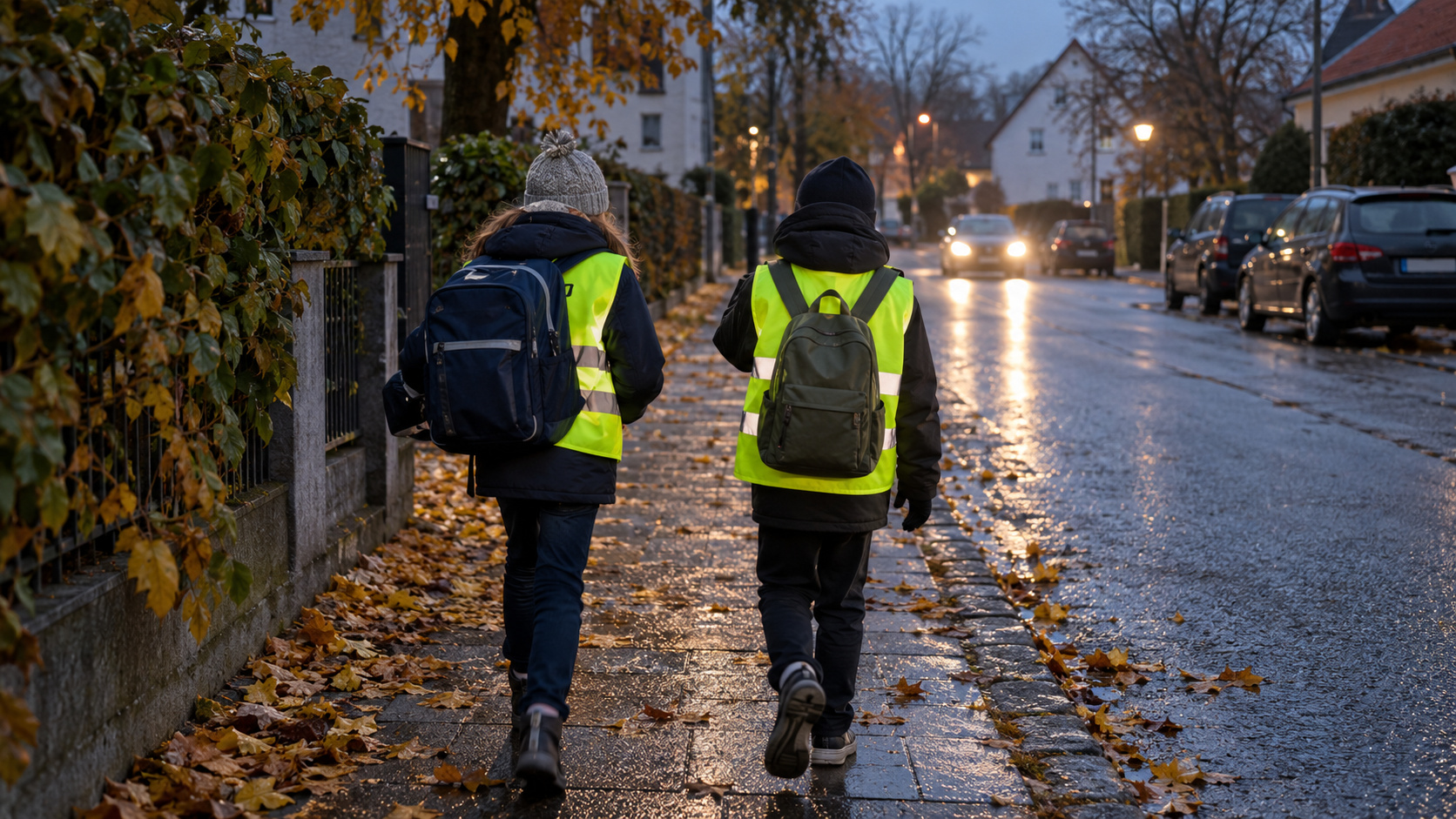
EN 17353 uses a single height threshold, 140 cm, to set two levels of minimum visibility area: one for smaller users, typically children, and one for everyone taller. For brands selling children’s reflective vests, school bibs, kids’ jackets and family ranges, this line decides how much fluorescent and reflective material each size needs.
This guide explains how the 140 cm rule works in EN 17353:2020+A1:2025 and what it means for children’s product development.
Minimum areas by user height
| Material | Type | User height ≤ 140 cm | User height > 140 cm |
|---|---|---|---|
| Fluorescent | A, AB2, AB3 | 0.14 m² | 0.24 m² |
| Retroreflective | B3, AB3 | 0.06 m² | 0.08 m² |
| Retroreflective | AB2 | 0.018 m² | 0.018 m² |
| Combined-performance | AB3 | 0.14 m² | 0.24 m² |
Types B1 and B2 do not change with height. A Type B1 device needs 0.003 m² across both sides; a Type B2 product needs 0.018 m² in total.
1. Why the standard splits by height
A child’s vest simply cannot carry the same 0.24 m² of fluorescent fabric as an adult vest without becoming a cape. The lower requirement for users up to 140 cm keeps children’s garments wearable while still requiring a meaningful visible area. Roughly, 140 cm corresponds to children around ten years old, but the rule is based on the size designation, not age.
2. Which sizes fall on which side of the line
Garment sizes are designated according to EN ISO 13688, which uses body height ranges. The requirement is chosen by the height range of the size:
- A size designed entirely for users up to 140 cm uses the lower column.
- A size designed entirely for users above 140 cm uses the higher column.
- A size whose range includes 140 cm, for example 138–142 cm, must meet the higher requirement.
That third rule catches many children’s ranges. A “10–11 years” size labelled 140–146 cm, or a size covering 134–146 cm, has to meet the adult figure. If the pattern was graded from a small base size, it may fall short.
3. Measure the smallest size in each range
For Type A, Type B3 and Type AB garments, the area is measured on the smallest size intended to be supplied in each height range, laid flat with all fasteners in the smallest configuration. For a range running from 104 cm to adult sizes, that means two checks:
- the smallest children’s size, against the ≤ 140 cm requirement;
- the smallest size above the line, or the size that straddles 140 cm, against the > 140 cm requirement.
The visibility-from-all-sides rules then apply to each checked size: at least 40 % of the minimum required area on the front and on the back, and at least 10 % on each side.
4. Design tips for children’s garments
- Use the shoulders and upper back. These areas are high on a small body and visible over car bonnets.
- Do not rely on the side panels alone. The 10 % side requirement is a minimum; front and back still need 40 % each.
- Keep reflective bands at least 20 mm wide and encircling the torso for Type B3 and AB3, with gaps no larger than the standard allows.
- Watch adjustable fit. Growth-adjustable side straps are popular in kids’ vests, but the area is measured with the straps at their tightest.
- Logos and school names do not count. Print over a dark area, or add extra fluorescent area to compensate.
5. Safety beyond visibility
Visibility is only one part of a child’s product. The standard reminds manufacturers to consider additional requirements for children’s products. Hanging Type B1 reflectors on children’s clothing, for example, raise questions about cords, small parts and strangulation risk. Toy-like reflectors may also fall under toy safety rules. Check these alongside EN 17353 before launch.
Children’s clothing must also meet the general ergonomic, innocuousness and sizing requirements of EN ISO 13688, including restrictions on harmful substances in materials in contact with skin.
6. A worked example
A brand develops a Type AB3 school vest in four sizes: 110–122 cm, 122–134 cm, 134–146 cm and 146–158 cm.
- The smallest size, 110–122 cm, must carry at least 0.14 m² of fluorescent material and 0.06 m² of retroreflective material.
- The 134–146 cm size includes 140 cm, so it is the smallest size in the higher range and must carry at least 0.24 m² of fluorescent material and 0.08 m² of retroreflective material.
- The 122–134 cm size sits entirely below the line and only needs the lower values, which it will exceed if graded up from the smallest size.
If the 134–146 cm size was graded from the children’s pattern and ends up at 0.20 m² fluorescent, it fails. The fix is to enlarge the fluorescent panels in that size or shift its height range so it no longer includes 140 cm.
FAQ
Does the 140 cm rule apply to armbands and hanging reflectors?
No. Type B1 and Type B2 minimum areas are the same for all users. Only Types A, B3, AB2 and AB3 change with height.
Can a one-size-fits-all children’s vest use the lower values?
Only if its declared height range stays entirely at or below 140 cm. If the range reaches above 140 cm, the higher values apply.
Is EN 17353 mandatory for children’s reflective vests?
If the product is marketed as PPE that signals the user’s presence, it falls under the PPE Regulation, and EN 17353 is the harmonised route for medium-risk situations. Decorative reflective details without a visibility claim are treated differently.
Conclusion
The EN 17353 140 cm rule is simple to state and easy to get wrong in a graded size range. Map every size against the line, treat any size that includes 140 cm as an adult size, and measure the smallest size on each side. Getting the size chart right at the design stage saves a failed test later.
This article provides general technical information, not a product-specific conformity assessment or legal opinion. Consult the current standard and the responsible laboratory or conformity-assessment body for the actual product and intended use.