
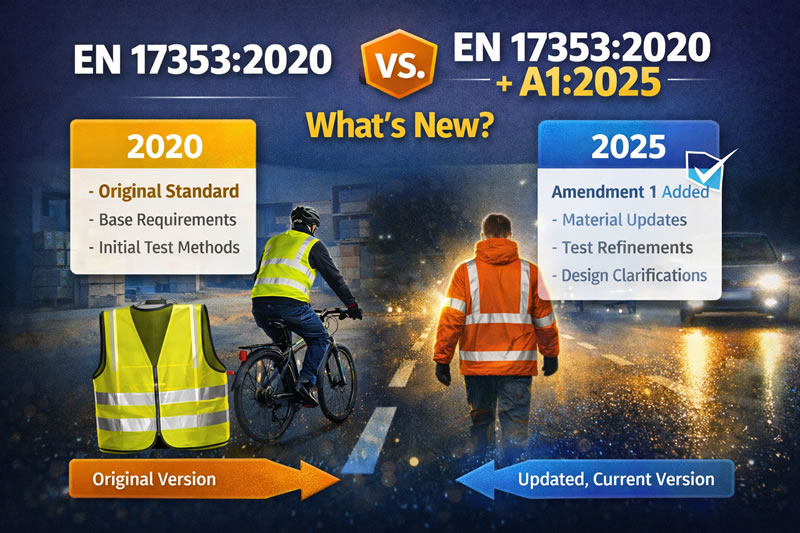
At first glance the two names look almost the same — but EN 17353:2020 +A1:2025 represents a clearly updated and technically revised version of the original EN 17353:2020 standard. The suffix “+A1:2025” means that a formal amendment (Amendment 1) was incorporated in 2025.
1. EN 17353:2020 — Original Standard (2020)
First published in 2020 by the European Committee for Standardization (CEN).
Defines requirements and test methods for enhanced visibility equipment and garments intended for medium‑risk situations such as cycling, walking, slow‑moving traffic, warehouse operations, etc.
Scope includes:
✔ Fluorescent and retroreflective materials
✔ Minimum material areas
✔ Placement requirements
✔ Types “A”, “B” and “AB” for daytime, nighttime, or combined use
✔ Test methods for photometry, colour, ageing, durability, etc.
This version already replaced earlier standards like EN 1150:1999 and EN 13356:2001, consolidating medium‑risk visibility requirements into one document.
2. EN 17353:2020 +A1:2025 — 2025 Amendment Integrated
The 2025 A1 Amendment was created to update and revise technical elements in the original 2020 text. The consolidated standard supersedes the original version by incorporating this amendment directly into the main document.
What does “+A1:2025” mean?
📍 A1 = Amendment 1 — a formal modification to the standard
📍 2025 = the year this amendment was approved by CEN and published as part of the consolidated standard
After A1 was approved, the original EN 17353:2020 was no longer the current version — instead, EN 17353:2020 +A1:2025 became the valid reference.
What Changed With the Amendment?
The published revision typically includes updates such as:
Updated material performance criteria
▪ Modified photometric and colour performance conditions
▪ Adjusted area requirements or placement rules
▪ New or refined durability and ageing test details
Clarifications in definitions and testing procedures
▪ Better alignment with referenced CIE and ISO test methods
▪ More precise measurement protocols for retroreflectivity and colour
Conformance and scope refinements
▪ Clearer application limits (e.g., excludes head/hand/foot gear and active lighting devices)
▪ Explicitly supersedes the original 2020 version
Summary: Key Differences
| Feature | EN 17353:2020 | EN 17353:2020 +A1:2025 |
|---|---|---|
| Publication | 2020 | 2025 (amendment included) |
| Amendment | None | Amendment 1 (A1) included |
| Status | Original version | Current, superseding version |
| Technical Updates | Base requirements | Material, test, and design refinements |
| Applicability | Medium‑risk visibility | Medium‑risk visibility with updated specifications |
In practical terms, EN 17353:2020 +A1:2025 is the only standard you should reference today, because it is the officially updated and consolidated version that replaces the 2020 edition.
Why It Matters for Your Products
✔ If your products are certified to the original EN 17353:2020, you need to check whether they meet the A1:2025 amendment requirements.
✔ Test labs and notified bodies will now evaluate against EN 17353:2020 +A1:2025, so compliance reports should reference the updated standard.
✔ Marketing claims (e.g., CE marking related to medium‑risk visibility) should use the current standard designation.