
When manufacturing or sourcing enhanced visibility equipment for medium-risk situations, staying compliant with European standards is critical. The European Committee for Standardization (CEN) recently rolled out EN 17353:2020+A1:2025, an amendment that brings a much-needed fix to the industry.
For buyers and manufacturers of reflective workwear—especially those dealing with custom high visibility shirts and lightweight jackets—the most significant change isn’t a brand new category, but the correction of a major loophole regarding Type AB garments.
If you produce or purchase equipment meant to be visible in daylight, twilight, and dark conditions, here is why the new A1:2025 update is a game-changer for Type AB2 and AB3 designs.
The Problem with the Original 2020 Standard
In the original EN 17353:2020 standard, “Type AB2” and “Type AB3” were briefly mentioned as concepts , but they were lumped together in the most critical section: the minimum material area requirements.
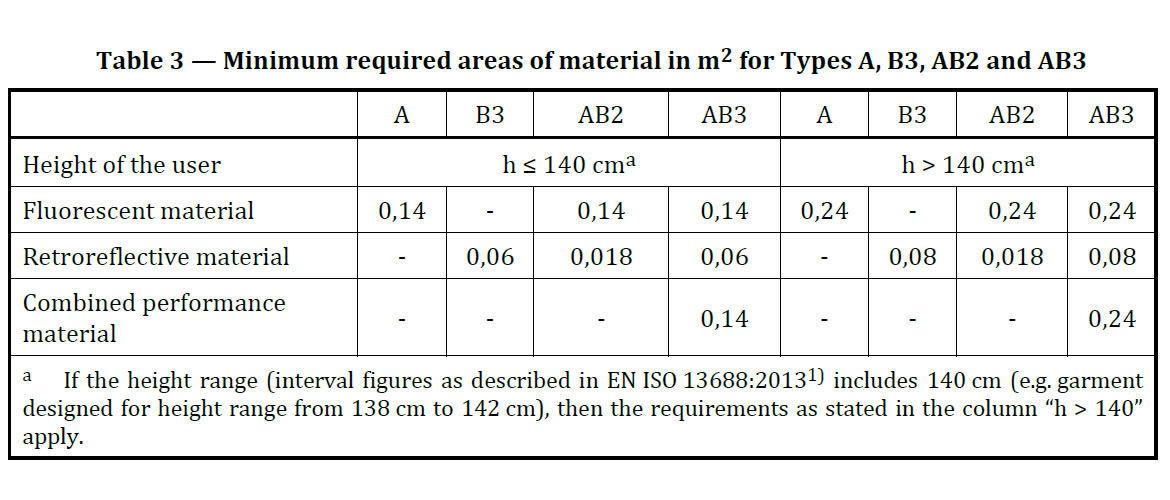
This created a massive headache for manufacturers. Whether you were designing a shirt with simple reflective armbands (AB2) or a vest with heavy torso striping (AB3), the 2020 standard often forced both designs to meet the same strict retroreflective area requirement (minimum 0.08m2 for taller users). For limb-focused AB2 garments, this requirement was excessively high, resulting in clunky designs and wasted material.
The A1:2025 Solution: Distinct Requirements for AB2 and AB3
The EN 17353:2020+A1:2025 amendment officially splits the requirements, giving Type AB2 and AB3 their own distinct definitions based on their function in the dark , and most importantly, separate area metrics.
Let’s break down the updated requirements.
Type AB2: Optimized for Movement Recognition
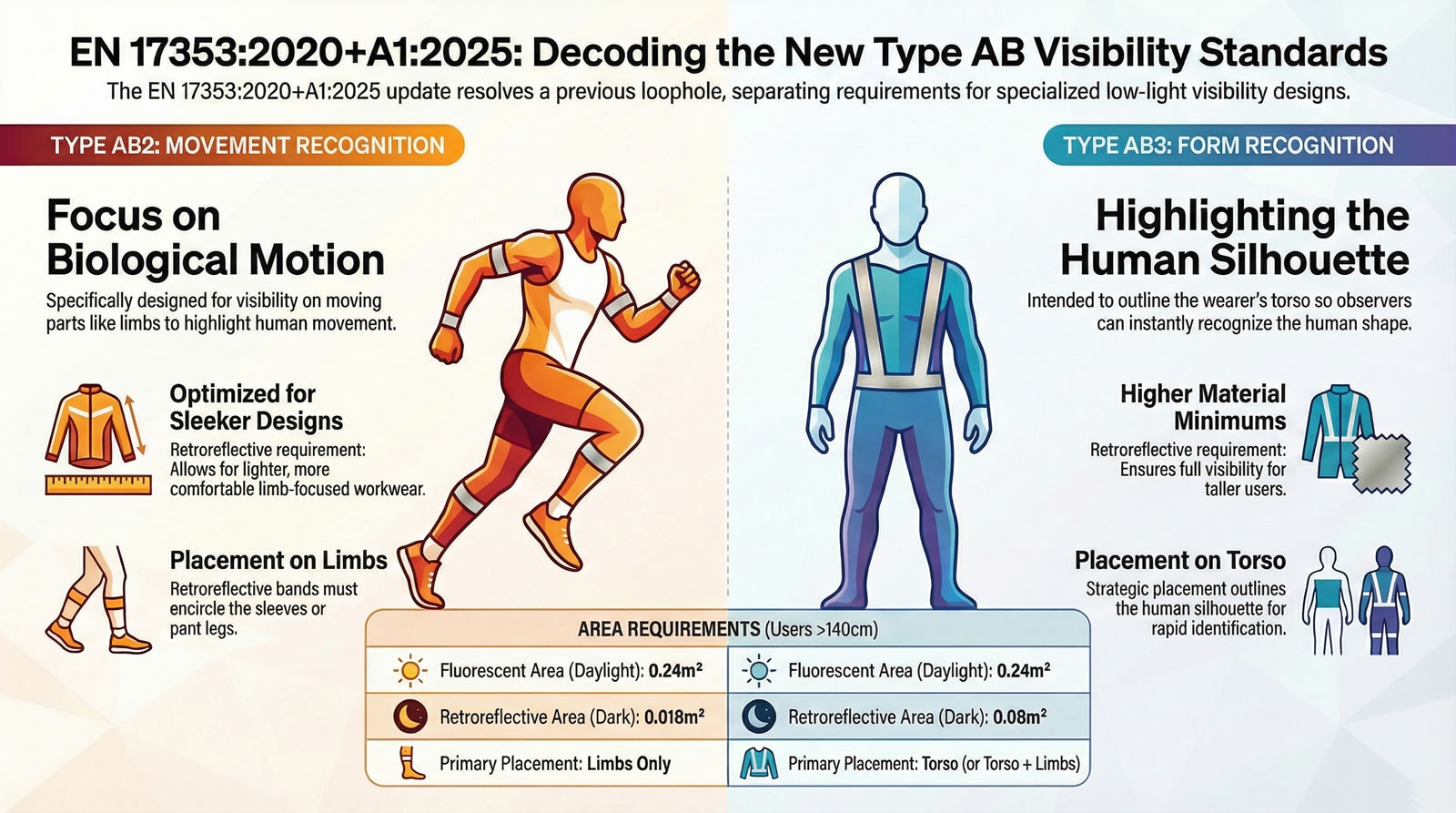
Type AB2 equipment is explicitly designed for movement recognition in dark conditions. By placing reflective materials on moving parts (the limbs), drivers can quickly recognize the biological motion of a worker.
-
Placement: Retroreflective material must be applied to the limbs (e.g., bands encircling the sleeves or pant legs).
-
Fluorescent Area (Daylight): Requires a minimum of 0.14m2 for users and 140 cm in height, and 0.24m2 for taller users.
-
Retroreflective Area (Dark): The crucial fix. AB2 now only requires a minimum of 0.018m2 of retroreflective material. This massive reduction allows for sleeker, more comfortable designs without failing certification.
Type AB3: Optimized for Form Recognition
Type AB3 is intended for form recognition. Instead of highlighting movement, it outlines the wearer’s torso so observers can instantly recognize the human shape.
-
Placement: Retroreflective material must be placed on the torso, or the torso and limbs.
-
Fluorescent Area (Daylight): Identical to AB2 (0.14m2 or 0.24m2 depending on height).
-
Retroreflective Area (Dark): Because it highlights the torso, it still requires a larger reflective surface area. It mandates a minimum of 0.06m2 for users and 140 cm, and 0.08m2 for taller wearers.
Why This Matters for Your Next Order
For safety managers and B2B buyers, the A1:2025 update removes the guesswork and unnecessary material costs from product certification. When you order custom high visibility shirts, you can now optimize your design specifically for AB2 (limb-focused movement) using just 0.018m2 of reflective tape, saving costs while remaining 100% compliant.
Our production lines are already updated to meet the EN 17353:2020+A1:2025 specifications. Whether you need sleek, cost-effective AB2 workwear or highly conspicuous AB3 shirts, we have the technical expertise to ensure your gear is perfectly compliant.