


If you import, distribute or specify reflective clothing and accessories for the European market, you have probably asked: does EN 17353 replace EN 1150? The short answer is yes. This article explains exactly what that replacement means for your product line, including the new Type A, Type B and Type AB categories, expanded color and area choices, and the transition timeline for existing certificates. We also compare EN 17353 with EN ISO 20471 so you can place each standard correctly.
en17353.com is run by Yuyao Kean Reflective Products Co., Ltd., a manufacturer of reflective products for the European market. We hold valid EN 17353 certificates for Type B1 soft reflective pendants, Type B2 slap bands, Type B2 elastic arm bands, and a children’s harness. Our materials include 3M Scotchlite and Reflexite reflective tapes.
Does EN 17353 Replace EN 1150? (The Short Answer)
Yes. EN 17353:2020+A1:2025 has replaced both EN 1150 and EN 13356 as the harmonised standard for enhanced visibility equipment in medium-risk situations. EN 1150 covered visibility clothing for non-professional use, while EN 13356 covered visibility accessories such as armbands and pendants. The new standard consolidates both into one framework with three main equipment types. If you currently hold EN 1150 certificates, they are no longer sufficient for CE marking after the transition period we describe below.
This means every importer or distributor still carrying EN 1150 labelled stock needs to plan a switch. The standard does not change the fundamental PPE obligation: if a product claims to make the wearer more visible, it remains PPE under Regulation (EU) 2016/425 and requires CE marking.
Key Differences Between EN 1150 and EN 17353:2020+A1:2025
Several differences matter for product design and certification:
- Daytime vs nighttime certification. EN 1150 only allowed certification for 24-hour visibility. EN 17353 allows a garment to be certified specifically for daytime use (Type A) or nighttime use (Type B), which can reduce material cost if only one visibility condition is needed.
- Sizing categories. EN 17353 reduces the sizing categories from the EN 1150 grouping to fewer groups, based on user height. This change effectively lowers the minimum area requirements for fluorescent and reflective materials compared with EN 1150.
- New device types. EN 17353 introduces Type B1 free-hanging reflectors and Type B2 limb reflectors, which did not exist under EN 1150. These are useful for products like slap bands and pendants.
- Retroreflective performance. For Types B2, B3, AB2 and AB3, the retroreflective material requirements are specific to the applicable standard and equipment type. For Type B1 retroreflective devices, the performance requirements are those specified for that device type in the applicable standard.
- Risk category. EN 17353 equipment falls into PPE Category 2, which triggers employer obligations under EU safety directives, as explained later.
For a detailed look at the standard itself, see our comprehensive guide to EN 17353:2020+A1:2025.
Understanding the New Categories: Types A, B, and AB
EN 17353 defines three main types of enhanced visibility equipment:
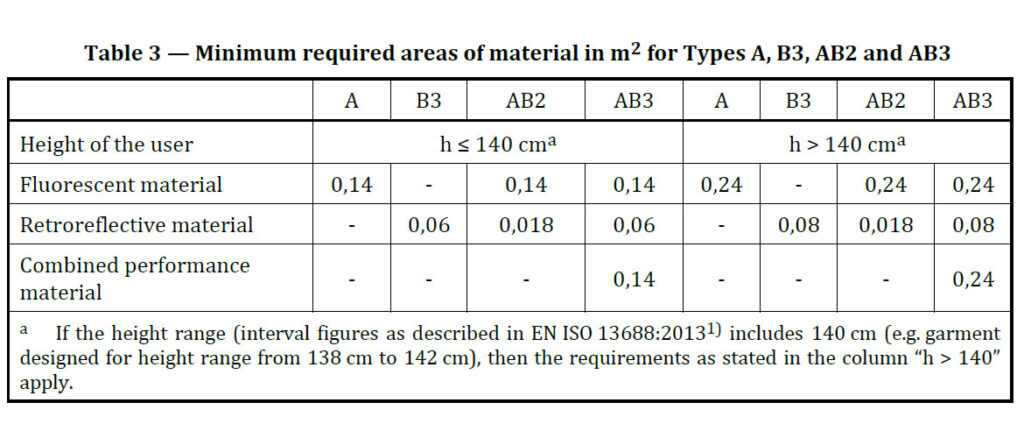
- Type A – Fluorescent material only, for daytime visibility. The garment must meet minimum fluorescent area and color requirements but does not need retroreflective elements.
- Type B – Retroreflective material only, for nighttime or low-light visibility. Type B is split into three levels:
- B1 – Free-hanging reflectors, such as pendants, designed to be recognized by their movement.
- B2 – Retroreflective materials on the limbs, such as arm bands or slap wraps.
- B3 – Retroreflective materials on the torso, or on the torso and limbs.
- Type AB – Combines fluorescent material for daytime and retroreflective material for nighttime, evaluated for both conditions. It is the closest equivalent to traditional high-visibility garments but with lower area requirements than EN ISO 20471.
Minimum area requirements differ by type. For adult garments, the minimum fluorescent area for Type A and Type AB is determined by the applicable type and sizing requirements. For reflective material, the minimum area is specified separately for Type B3 or AB3, and for Type AB2. Children’s garments (height ≤ the applicable size-category threshold) have their own lower area requirements.
Type B2 products are popular for accessories like arm bands; see our Type B2 explained page for specifics.
Design Freedoms: Expanded Colors and Area Requirements
One of the practical benefits of EN 17353 is that it allows a wider range of fluorescent colors than EN ISO 20471. Under EN 17353, the fluorescent material may be any of the following seven colors: yellow-green, yellow, yellow-orange, orange, orange-red, red, and pink. This gives designers more freedom to match brand colors while still meeting the standard’s chromaticity and luminance requirements.
EN ISO 20471, by contrast, allows only fluorescent colors that meet its color requirements. Non-fluorescent colors such as blue or black cannot be used for the certified fluorescent area in EN 17353, but they can be used on non-fluorescent parts of the garment, or for Type B products that rely only on retroreflective material. This means a black background with retroreflective bands can be certified as Type B without any fluorescent fabric.
The reduction in sizing categories also means smaller garments can meet the standard more easily, which is particularly useful for children’s products and promotional items.
Transitioning Your Certificates: What Buyers Need to Know
If you currently hold EN 1150 product certificates, you need to act now. Under Regulation (EU) 2016/425, EU type-examination certificates are generally valid for a limited period stated on the certificate. Most EN 1150 certificates issued before the withdrawal of EN 1150 will expire during the final year of their stated validity. After that, you cannot legally place those products on the EU market with CE marking based on the old standard.
Transition steps for importers and distributors:
- Review your current certificate list and identify all products certified under EN 1150 or EN 13356.
- Contact your notified body or test laboratory to confirm whether your products can be certified under EN 17353 without design changes, or whether modifications are needed.
- Update the technical file and EU declaration of conformity to reference EN 17353:2020+A1:2025.
- Change product labelling and user information to show the new standard and type classification (e.g., EN 17353 Type B2).
- For any new orders, specify EN 17353 compliance in your purchase contracts and check the supplier’s certificate validity.
Because EN 17353 equipment is PPE Category 2, European employers have additional obligations: they must provide the equipment free of charge to workers, ensure hygienic reprocessing between uses, and provide annual training on correct use. If you sell to corporate or institutional buyers, these obligations are part of the value proposition, not just a legal note.
EN 17353 vs. EN ISO 20471: Medium vs. High Risk Environments
A recurring question from buyers is whether EN 17353 replaces EN ISO 20471. It does not. EN 17353 is for medium-risk situations; EN ISO 20471 remains the standard for high-risk professional use near traffic. The two standards are designed for different applications.
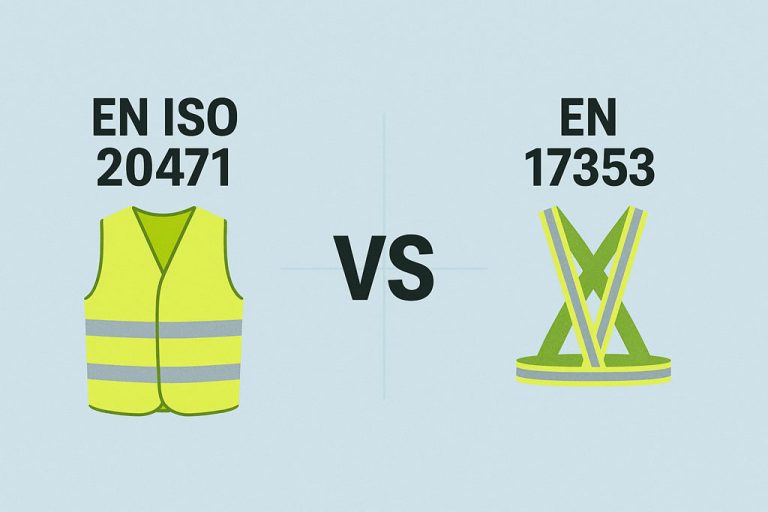
In our experience, the main differences are:
- Risk level: EN 17353 suits cycling, running, pedestrians and low-speed work areas. EN ISO 20471 is required for professional workers exposed to high-speed traffic or dangerous machinery.
- Fluorescent colors: EN 17353 allows seven colors; EN ISO 20471 allows only fluorescent colors that meet its color requirements.
- Area requirements: EN 17353 has lower minimum areas. For example, fluorescent area for adult EN 17353 A/AB is determined by the applicable type and sizing requirements, while EN ISO 20471 requires minimum fluorescent areas according to garment class. Reflective area for EN 17353 B3/AB3 is determined by the applicable type and sizing requirements, while EN ISO 20471 requires minimum reflective areas according to garment class.
- Design: EN 17353 includes device types B1 and B2 that do not require encircling the torso; EN ISO 20471 requires specific torso band arrangements.
- Children: EN 17353 has a separate set of requirements for users with height ≤ the applicable size-category threshold; EN ISO 20471 is not intended for children’s garments.
For a side-by-side comparison, read EN ISO 20471 vs EN 17353: Which Reflective Vest Standard Fits Your Needs?
Here at en17353.com, we manufacture EN 17353:2020+A1:2025 compliant products for the European market. Our certified range includes Type B1 soft reflective pendants, Type B2 slap bands, Type B2 elastic arm bands, and a children’s harness. We use premium reflective materials such as 3M Scotchlite and Reflexite to meet retroreflective performance requirements. If you need samples or certificates, contact us through the website.
FAQ
Does EN 17353 replace EN 1150?
Yes. EN 17353:2020+A1:2025 replaces both EN 1150 and EN 13356. EN 1150 certificates are no longer valid for CE marking after the transition period, which ends for most products in the 2024/2025 timeframe.
What is the difference between EN 17353 and EN ISO 20471?
EN 17353 is for medium-risk situations such as cycling, running and pedestrian visibility. EN ISO 20471 is for high-risk professional work near traffic. EN 17353 allows more fluorescent colors, lower minimum areas, and includes device types like B1 and B2 that EN ISO 20471 does not cover.
What is EN 17353 Type B2?
Type B2 covers retroreflective materials worn on the limbs, such as elastic arm bands or slap wraps. These products provide nighttime visibility by reflecting light from vehicle headlights. They must meet the same retroreflective material performance as EN ISO 20471, but the design and area requirements differ.
What is EN 17353 Type B3?
Type B3 covers retroreflective materials on the torso, or on the torso and limbs. A B3 garment like a reflective harness or cross-belt vest provides larger reflective coverage than a B2 limb band, improving visibility from multiple directions. The minimum reflective area for adults is determined by the applicable type and sizing requirements; our sales team can confirm the requirement for your product.
Disclaimer: This article is guidance based on our understanding of EN 17353:2020+A1:2025 and related EU regulations. The official standard text and notified body decisions always prevail.