
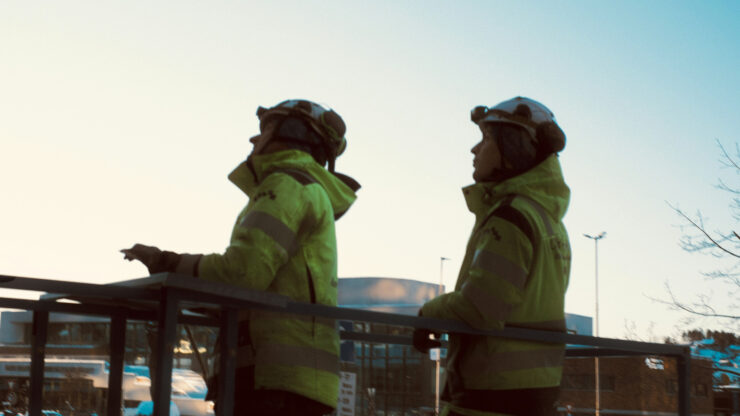
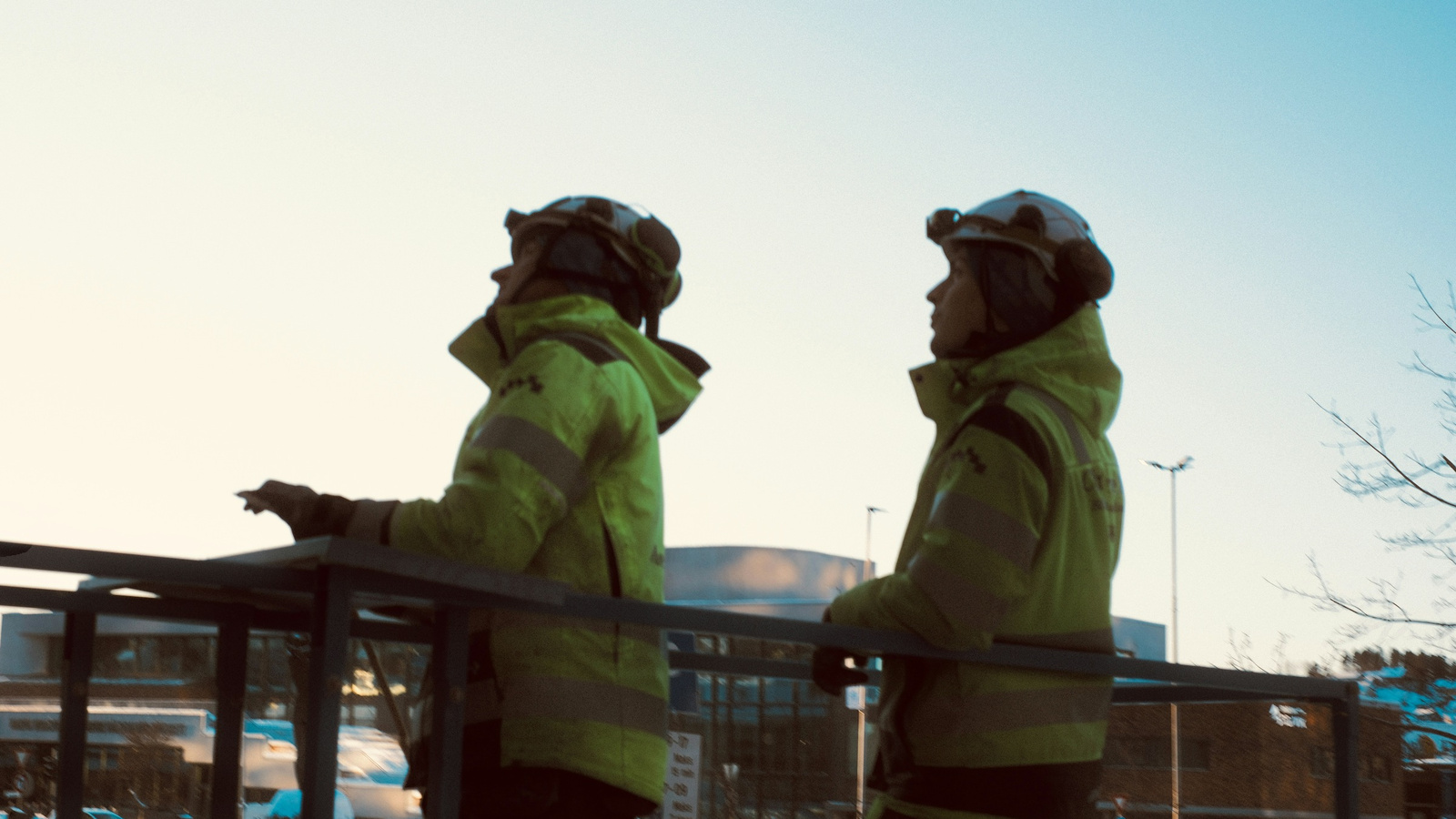
An EN 17353 Type AB3 safety vest must carry enough fluorescent material to be seen in daylight and enough retroreflective material on the torso to show a human shape in headlights. How much of each depends on one number: the wearer’s height.
This article turns the area rules of EN 17353:2020+A1:2025 into concrete numbers for children’s and adults’ vests, including how the material must be distributed around the body and how long the reflective tape needs to be.
AB3 minimum areas: children vs adults
| Material | Users up to 140 cm (children) | Users above 140 cm (adults) |
|---|---|---|
| Fluorescent (background) material | 0.14 m² (1,400 cm²) | 0.24 m² (2,400 cm²) |
| Retroreflective material | 0.06 m² (600 cm²) | 0.08 m² (800 cm²) |
“Fluorescent material” in EN 17353 is the same thing EN ISO 20471 calls “background material”: the bright yellow, orange or other fluorescent fabric that makes the wearer conspicuous in daylight.
1. Which column applies?
The height column is chosen by the size range of each garment size, designated according to EN ISO 13688:
- A size entirely for users up to 140 cm uses the children’s values.
- A size entirely above 140 cm uses the adult values.
- A size whose height range includes 140 cm, for example 134–146 cm, must meet the adult values.
That third rule is the one most children’s ranges miss. A size labelled “10–11 years / 140–146 cm” is an adult size for the purposes of EN 17353.
2. From totals to front, back and sides
Total area is not enough. For visibility from all sides, at least 40% of the minimum required area must be on the front and on the back, and at least 10% on each side, with the garment laid flat. The rule applies to the fluorescent material (as for Type A) and to the retroreflective material (as for Type B3).
| Minimum per view | Children | Adults |
|---|---|---|
| Fluorescent, front | 0.056 m² | 0.096 m² |
| Fluorescent, back | 0.056 m² | 0.096 m² |
| Fluorescent, each side | 0.014 m² | 0.024 m² |
| Retroreflective, front | 0.024 m² | 0.032 m² |
| Retroreflective, back | 0.024 m² | 0.032 m² |
| Retroreflective, each side | 0.006 m² | 0.008 m² |
The percentages are always taken from the minimum required area, not from the vest’s actual area. A vest with plenty of tape on the back and almost none on the front still fails.
3. How long does the reflective tape need to be?
Dividing the minimum area by the tape width gives a quick design check. These are visible lengths after deducting logos, measured on the smallest size:
| Tape width | Children (0.06 m²) | Adults (0.08 m²) |
|---|---|---|
| 50 mm | 120 cm | 160 cm |
| 30 mm | 200 cm | 267 cm |
| 25 mm | 240 cm | 320 cm |
At least one band of 20 mm or wider must encircle the torso, or alternatively the upper arms. Gaps in that band may not exceed 50 mm each or 100 mm in total around the torso, which is why buckles and closures need care.
4. Measure the right sample
Areas are measured on the smallest size intended to be supplied in each height range, with all fasteners closed to their smallest configuration and the vest laid flat. Areas covered by logos, lettering or labels do not count. A full size run from 110 cm to adult sizes therefore needs two checks: the smallest children’s size against the children’s values, and the smallest adult or 140 cm-straddling size against the adult values.
5. Using combined-performance material
Fluorescent retroreflective film or fabric, called combined-performance material, can count towards the fluorescent area. When it is used, the required fluorescent fabric area is reduced by the area of combined material, provided it is used in widths of at least 20 mm. Its retroreflective performance requirement is lower than that of silver tape, so check which table the material was tested against.
Worked example
An adult AB3 vest uses fluorescent yellow mesh and two 50 mm silver bands around the waist plus two over the shoulders. On the smallest adult size:
- Visible fluorescent area after deducting the tape and a chest logo: 0.27 m², split 0.12 front, 0.12 back, 0.015 each side. The total and front and back pass, but each side needs 0.024 m². The side panels must be widened.
- Reflective tape: 2 waist bands of 95 cm plus 2 shoulder bands of 60 cm at 50 mm gives 0.155 m², well above 0.08 m². The waist bands encircle the torso with a 30 mm buckle gap. This passes.
FAQ
Is there a required vest size, such as 45 × 45 cm?
No. EN 17353 regulates material areas and their distribution, not the garment’s length or width. Any pattern that meets the areas on the smallest size is acceptable.
Do B1 and B2 products change with height?
No. Free-hanging reflectors (B1) and limb bands (B2) have the same requirement for every user.
What about AB2?
AB2 uses the same fluorescent areas but only 0.018 m² of retroreflective material, placed on the limbs. It suits running tops with reflective cuffs.
Conclusion
For an EN 17353 AB3 vest, start from the height range, then design backwards from the numbers: 0.14 or 0.24 m² of fluorescent material, 0.06 or 0.08 m² of retroreflective material, 40% front, 40% back and 10% each side. Measure on the smallest size, and the certification test holds no surprises.
This article provides general technical information, not a product-specific conformity assessment or legal opinion. Consult the current standard and the responsible laboratory or conformity-assessment body for the actual product and intended use.