
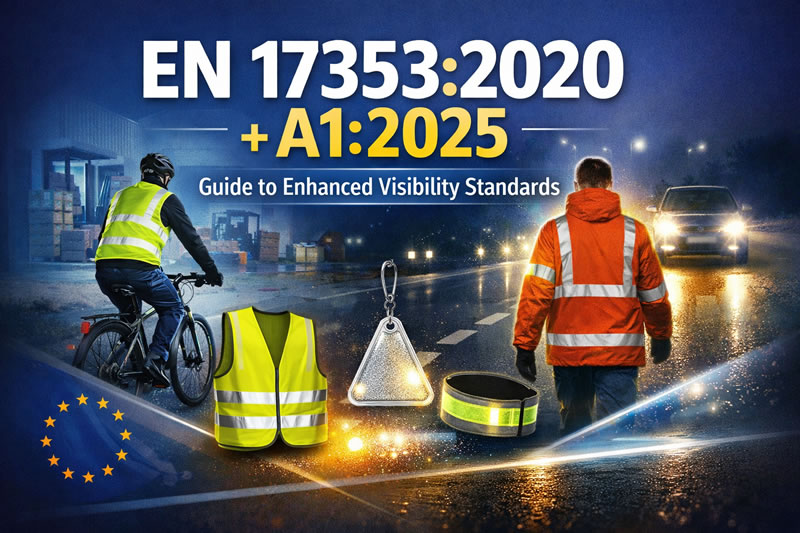
In 2025, the European Committee for Standardization (CEN) published an important update to the medium‑risk visibility standard: EN 17353:2020 +A1:2025. This revised standard provides clear test methods and performance requirements for enhanced visibility equipment designed for medium‑risk situations, bridging the gap between casual reflective accessories and high‑visibility protective clothing covered under EN ISO 20471.
What Is EN 17353:2020 +A1:2025?
EN 17353:2020 +A1:2025 is a European standard titled:
“Protective clothing — Enhanced visibility equipment for medium risk situations — Test methods and requirements.”
It specifies requirements and test procedures for garments and other devices that visually signal the user’s presence in medium‑risk environments — such as warehouses, cycling, jogging, event security, visitor vests, and other situations where enhanced visibility is important but full high‑visibility PPE may not be needed.
This standard combines the original EN 17353:2020 with Amendment 1 (A1), which was formally approved by CEN on March 7, 2025 and integrated into the consolidated text, published on June 24, 2025.
Why This Standard Matters
Before EN 17353, two older standards existed for visibility products:
-
EN 1150:1999 – Visibility clothing for non‑professional use
-
EN 13356:2001 – Visibility accessories for non‑professional use
Both were withdrawn in favor of a unified, more relevant benchmark — EN 17353.
By merging these legacy specifications and aligning visibility requirements with modern applications, EN 17353 enables manufacturers to certify products with consistent, measurable performance across daytime and nighttime conditions.
Scope and Purpose
EN 17353:2020 +A1:2025 applies to garments and devices that:
🔹 Provide conspicuity (visual signaling) of the wearer in medium‑risk situations.
🔹 Are effective under any daylight conditions and/or when illuminated by headlights or searchlights at night.
🔹 Include both fluorescent and retroreflective materials with defined performance thresholds for colour, retroreflection, and minimum material areas.
🔹 Are not intended for high‑risk work environments (these fall under EN ISO 20471) or for products with integrated active lighting (e.g., LEDs).
This standard helps manufacturers, designers, and safety professionals measure performance objectively and ensures that enhanced visibility products deliver real benefits in medium‑risk scenarios.
Key Technical Highlights
Here are some of the most important elements covered by EN 17353:2020 +A1:2025:
✔ Product Types
The standard defines several equipment types based on visibility goals:
-
Type A: Enhanced visibility primarily in daylight (fluorescent materials).
-
Type B: Night or low‑light visibility (retroreflective materials).
-
Type AB: Dual‑purpose products combining both daytime and nighttime visibility elements.
✔ Performance Requirements
Requirements include:
-
Minimum areas and placement of visibility materials to ensure effective conspicuity from required viewing angles.
-
Colour performance thresholds for fluorescent materials and retroreflective properties for night visibility.
-
Photometric performance and durability metrics that products must meet before and after exposure to real‑world conditions (e.g., abrasion, temperature cycles, washing).
✔ Test Methods
EN 17353 specifies standardized test methods for:
-
Colour measurements
-
Retroreflective performance under defined angles and lighting
-
Material ageing and resistance (e.g., xenon light, water immersion, mechanical stress)
-
Sampling and conditioning procedures for consistent lab results.
Who Uses EN 17353:2020 +A1:2025?
This standard is highly relevant for:
-
Manufacturers & Designers: To design, label, and certify enhanced visibility products for medium‑risk use.
-
Testing Laboratories: To apply consistent performance verification procedures.
-
Procurement & Safety Managers: To select compliant products based on documented performance criteria.
-
Compliance & Conformity Bodies: To tie visibility claims to recognized European standards.
Standard vs. High‑Visibility PPE
It’s important to note that EN 17353 does not replace high‑visibility PPE standards like EN ISO 20471. Instead:
-
EN 17353 targets medium‑risk environments with flexible design allowances and visibility performance that fits everyday safety usage (e.g., warehouse workers, cyclists, event staff).
-
EN ISO 20471 remains the benchmark for high‑risk occupational PPE (e.g., roadwork crews, construction zones).
Summary
EN 17353:2020 +A1:2025 represents an important evolution in visibility standards — offering clear, updated requirements for enhanced visibility equipment in medium‑risk situations. It helps close the gap between casual reflective accessories and full high‑visibility protective gear by providing objective performance criteria, test methods, and design guidance that align with modern safety needs.
Manufacturers, compliance teams, and safety professionals should prioritize understanding and applying this standard when developing or evaluating products intended to improve wearer conspicuity where medium visibility performance is important.