
Enhanced visibility products certified under EN 17353:2020 are widely used in medium-risk environments where workers or road users need to be recognized under daylight, twilight, or dark conditions.
Among all product types in the standard, Type B2 (equipment for limbs) is one of the most common categories for manufacturers producing reflective trousers, armbands, or products where the reflective function is limited to the arms or legs.
Recently, our team encountered an interesting and representative situation while preparing one of our reflective trousers for EN 17353 Type B2 certification.
This case involved a technical misunderstanding that even an international test laboratory engineer initially interpreted differently—but through careful analysis of the standard, the issue was resolved smoothly.
In this article, we share the technical clarification, the reasoning behind the classification, and key insights for manufacturers working with EN 17353.
1. The Question: Does Fluorescent Fabric Disqualify Trousers from Type B2?
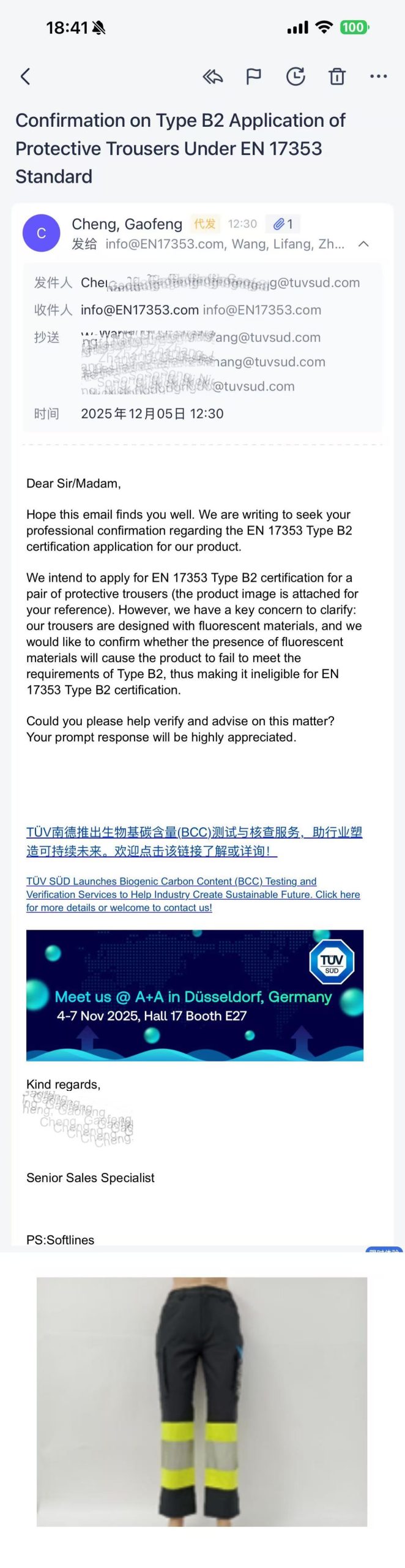
During the certification discussion, a TUV engineer raised a concern:
The trousers include fluorescent yellow fabric.
Would this mislead users into thinking the product provides daytime visibility?
And therefore, does the presence of fluorescent material make the trousers ineligible for EN 17353 Type B2?
This question is understandable, because many people intuitively associate fluorescent material with daytime visibility and assume that any product containing it must fall under Type A (daylight-only visibility) or Type AB (day + night visibility).
However, this assumption does not reflect how EN 17353 classifies products.
To provide the correct answer, we must go back to the structure of the standard itself.
2. Understanding EN 17353 Classification: Function Determines Type, Not Materials Alone
EN 17353 defines visibility equipment based on the function that the materials provide, not simply whether certain materials are present.
The three functional categories are:
Type A
Daylight visibility only
(requires sufficient fluorescent material arranged according to Annex C and Table 3)
Type B (B1 / B2 / B3)
Night visibility only
(requires retroreflective material according to Table 2)
Type AB (AB2 / AB3)
Day + night visibility
(requires both fluorescent AND retroreflective materials meeting the requirements of A + B)
This structure reveals a key principle:
The presence of fluorescent material does NOT automatically give the product daytime visibility.
A product qualifies for Type A or Type AB ONLY if its fluorescent material meets the minimum area and visibility-from-all-sides requirements.
Therefore:
Fluorescent material may exist on a Type B2 product as long as it does not fulfil Type A performance.
This is perfectly allowed by the standard.
3. What Does Annex B Say About Trousers?
Annex B provides examples of each type.
For Type B2, one of the listed examples is:
“Trousers with reflective in the legs only.”
A very important linguistic clarification is needed here:
-
The wording “reflective in the legs only” means
the retroreflective material is located only on the limbs,
NOT
“the trousers must contain only retroreflective material and nothing else.”
If the standard intended to prohibit fluorescent material, it would explicitly state so.
But it does not.
The purpose of the sentence is to classify products based on the location of the retroreflective material, not to restrict the presence of additional materials.
Therefore:
As long as the reflective material is located on the legs only, trousers fall under Type B2.
Fluorescent areas do not change this classification.
4. Does Fluorescent Fabric Mislead Users? A Regulatory Perspective
TUV’s engineer raised a reasonable point:
Could fluorescent fabric cause users to believe the garment provides daytime visibility?
Under the PPE Regulation (EU) 2016/425, this is considered a user information issue, not a structural or material non-compliance.
The regulation requires:
-
Clear labeling
-
Correct declaration of the protection level
-
IFU (Instruction for Use) wording that prevents misunderstanding
Therefore:
If a product does not meet Type A requirements, the IFU must simply clarify that it is certified as Type B2 and does not provide daytime visibility.
This eliminates the risk of misunderstanding without affecting the technical classification.
For example, the IFU can state:
“This product is certified as EN 17353:2020 Type B2 for night-time visibility of limbs.
The fluorescent components do not constitute a daytime visibility function.”
Such a statement fully resolves the concern.
5. Minimum Material Requirements for Type B2
For Type B2 devices, the standard requires:
Retroreflective material minimum area:
0.018 m² = 180 cm² (Table 2)
There is:
-
No minimum fluorescent area requirement
-
No restriction preventing fluorescent materials from being present
Thus, if the trousers contain:
-
≥180 cm² of retroreflective material
-
Retroreflective material placed only on the legs (limbs)
-
Adequate reflective width (≥20 mm) and continuity requirements
Then the product fully meets Type B2.
6. Final Resolution: Why TUV Accepted the Classification
After we provided:
-
A clear explanation of the EN 17353 structural logic
-
Clarification that fluorescent fabric does not fulfil Type A requirements
-
Confirmation that the trousers still function purely as a night visibility device
-
A commitment to clarify this in the IFU
-
Reference to Annex B’s example of trousers with reflective-on-legs-only
TUV engineers fully agreed with the interpretation and accepted the trousers as Type B2.
This demonstrates the importance of thoroughly understanding the standard—not only for compliance, but also for effective communication with certification bodies.
7. Key Takeaways for Manufacturers
Here are the main lessons from this case:
1. Fluorescent material ≠ automatic Type A or AB
Only materials meeting Table 3 + Annex C qualify for daytime visibility.
2. Type B2 classification depends on reflective placement (limbs only)
Not on whether fluorescent fabric exists.
3. Standards regulate functionality, not colors
Material presence alone does not redefine product type.
4. User misunderstanding is resolved through labeling & IFU
Not through banning certain materials.
5. Annex B examples are functional, not restrictive
“Trousers with reflective in the legs only” ≠ “trousers containing only reflective material.”
8. Conclusion
This case illustrates a common misunderstanding in EN 17353 interpretation.
As more manufacturers combine different materials into PPE products, understanding the functional approach of EN 17353 becomes increasingly important.
At Yolite, we continue to provide reflective products that comply with EN 17353 and EN ISO 20471, and to support our customers with technical guidance and certification assistance.
If your company needs support with EN 17353 Type A / B / AB classification, material evaluation, or technical file preparation, our team is ready to help.