5.1 Size designation
The size designation for garments shall be in accordance with the requirements of EN ISO13688:2013.5.2 Type A
5.2.1 General
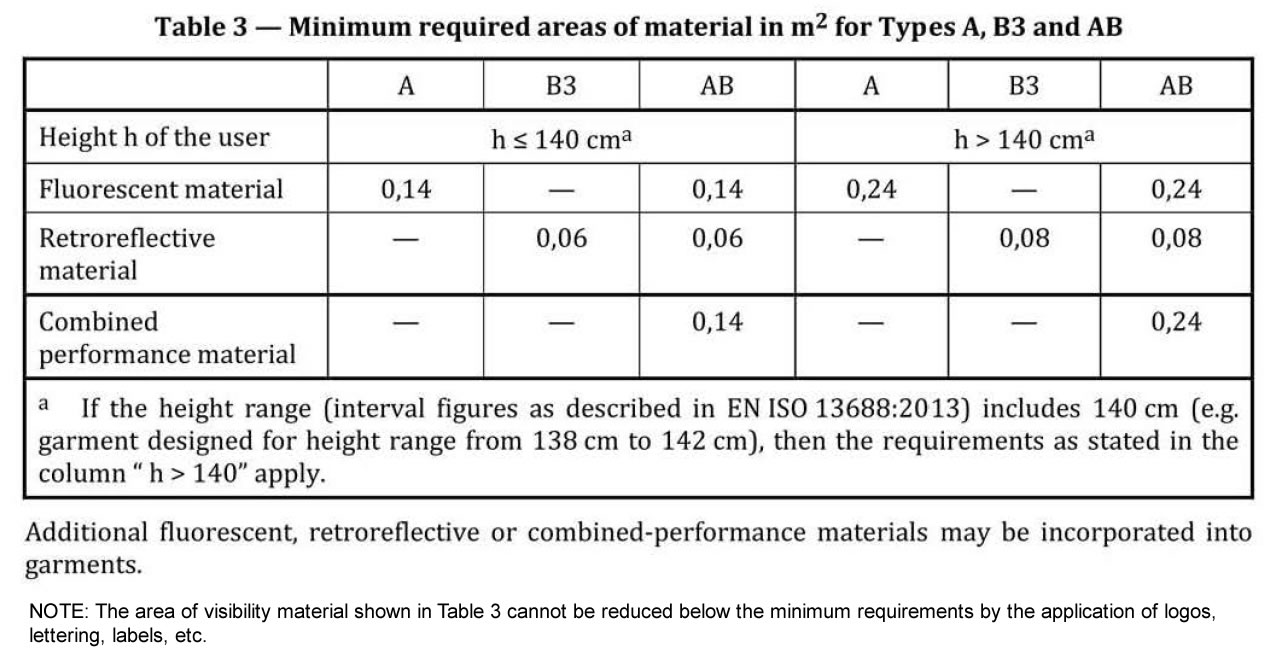
Type A garments (including partial body protective clothing) shall in their design use at least the minimum amount of fluorescent material according to Table 3.
NOTE 1: Protective clothing items are worn to cover one or more parts of the body, examples of partial body protection are sleeves, aprons and chaps.
The areas shall be measured on the smallest garment size intended to be supplied, in each of the two height ranges specified in Table 3, with all fasteners adjusted to the smallest configuration possible and with the garment laying flat on a table. Fluorescent material areas covered by any logos, lettering, labels etc., are not counted towards the total area.
NOTE 2: Conspicuity is best achieved by having well-defined areas of fluorescent material. Fragmented or highly patterned areas are unsuitable.
5.2.2 Visibility from all sides
Type A garments shall be made up of fluorescent material on all sides to ensure 360° visibility (visibility from all sides). For upper body garments, fluorescent material shall be evenly distributed around the torso and/or upper arms and/or limbs, if any. For lower body garments, fluorescent material shall be evenly distributed around the legs.
Visibility from all sides shall be reached as follows:
- Not less than 40% of the minimum required amount of fluorescent material specified in Table 3 is present on both the front and the back when laid flat, and
- Not less than 10% of the minimum required amount of fluorescent material specified in Table 3 is present on both the right and left sides when laid flat on the back (respectively on the front).
Annexes C and D show examples of designs and how to measure visibility from all sides.
5.3 Type B
5.3.1 General
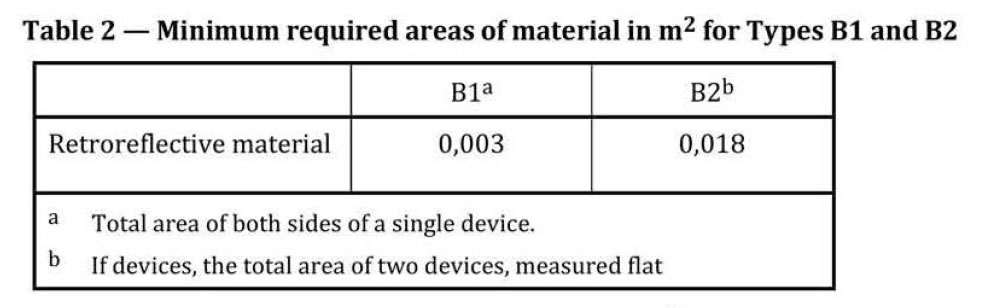
These garments or devices shall in their design use at least the minimum amount of retroreflective material according to Table 2 or Table 3.
5.3.2 Type B1 – Free hanging devices
The devices shall be removable. The total area of the devices in use shall meet the requirements in Table 2. A Type B1 device shall be retroreflective from both sides. Its optical active area shall be a minimum 15 cm² per side. The total area shall be a maximum of 50 cm² per side.
In order to achieve 360° visibility (visibility from all sides), at least two devices shall be used. These shall be used on the left and the right side of the torso. This shall be specified in the user information.
The device shall be flat and its maximum thickness shall be 10 mm. The means of attachment (string, ribbon, cord, spiral, etc.) shall be a minimum 10 cm in length between the points of attachment on the garment and that on the reflector to enable free movement of the device around its vertical axis and allow a pendulum effect.
NOTE: Consider additional requirements applicable for children’s products.
5.3.3 Type B2 – Equipment for limbs
The minimum area of retroreflective material shall fulfil the requirements in Table 2. To ensure 360° visibility (visibility from all sides), one or more devices shall be applied to each upper and/or each lower limb.
When retroreflective material is applied to a garment, it shall also be positioned to achieve 360° visibility. The material shall be placed on the limbs to ensure a minimum width of 20 mm encircling each limb.
Any gap in the lengthwise continuity of the retroreflective material shall not be greater than 50 mm, measured parallel to the direction of the material, and the total of such gaps shall not be greater than 50 mm around the limbs. Any offset not greater than the width of the material plus 5 mm is allowed.
Additionally, separate retroreflective elements may form part of an applied design in conjunction with the above. The retroreflective elements shall have a minimum area of 25 cm² each.
In the case of B2 garments covering upper and lower limbs, the retroreflective material can be applied on the upper limbs only, on the lower limbs only, or on both the upper and lower limbs. In the latter case, the minimum amount of Table 2 shall be used for upper limbs and also for the lower limbs.
NOTE: An example of a B2 garment is shown in Annex E.
5.3.4 Type B3 – Equipment for the torso or the torso and limbs
The minimum area of retroreflective material shall fulfil the requirements in Table 3. Garments and devices shall be measured flat and in their smallest configuration.
Retroreflective material shall be placed on the torso to ensure a minimum width of 20 mm encircling the torso. Alternatively, retroreflective materials may be placed to encircle the upper arms.
If a B3 garment covers limbs below the elbows or knees, then retroreflective material on the limbs is required. In this case, Type B2 requirements (see 5.3.3) for the limbs shall be fulfilled whilst the remainder of the material shall be placed on the torso. It is not necessary for a minimum 20 mm wide band to be applied on the limbs in this case.
Additionally, separate retroreflective elements may form part of an applied design in conjunction with the above. The retroreflective elements shall have a minimum area of 25 cm² each.
Visibility from all sides shall be reached as follows:
- Not less than 40% of the minimum required amount of retroreflective material specified in Table 3 is present on both the front and the back when laid flat, and
- Not less than 10% of the minimum required amount of retroreflective material specified in Table 3 is present on both the right and left sides when laid flat on the back (respectively on the front).
5.4 Type AB
These garments shall in their design use the minimum amount of fluorescent material and retroreflective material or combined performance material of appropriate group according to Table 3.
Design requirements for Type AB clothing shall follow the same rules in terms of distribution of fluorescent material as applied to Type A in 5.2. Design requirements for Type AB clothing shall follow the same rules in terms of distribution of reflective material as applied to Type B2 as in 5.3.3 or Type B3 in 5.3.4.
Combined performance material shall be used only in a form that maintains a width of ≥20 mm. When using combined performance material, the area of fluorescent material can be reduced by the amount of combined performance material used.